

The most thrilling part of online betting isn’t the final score. It’s the moment you fund your account and feel that rush of possibility. But here’s the intellectual’s first move: pumping money in is the last step, not the first.
Think of it like building a house. You wouldn’t start decorating before laying a foundation on solid, licensed ground. Gambling in an unapproved, gray-market sportsbook is like building on quicksand—or investing your life savings in Beanie Babies circa 2024.
Your true starting line is choosing a state-approved operator. This isn’t bureaucracy; it’s your legal force field. Next, activate two-factor authentication (2FA). Consider this your digital deadbolt.
Then, embrace the modern ritual of KYC—submitting your ID and proof of address. It’s a minor hassle for major access, like getting a backstage pass. It verifies your identity and keeps the ecosystem secure.
Lastly, we get to the profoundly unsexy but critical act: setting deposits limits from day one. This is the smart bettor’s version of a pre-nup, protecting your future self from your present, impulsive enthusiasm. Responsible play isn’t a buzzkill; it’s the strategy that lets you stay in the game.
This guide will walk you through that essential foundation. Because knowing how to play safely is the ultimate advantage.
Step-by-Step Deposit Walkthrough (mobile and desktop)
Trying to deposit money at a sportsbook can feel like a puzzle. It’s like a journey with many twists and turns. Think of this as your guide through this digital maze.
We’ll break down the deposit process for both mobile and desktop. It’s like a movie where you know what to do next. You’ll learn where to click and how to get your account funded. Let’s begin with the desktop version.
The Desktop Dominion: A Logical, If Cluttered, Path
On desktop, the steps are clear but a bit confusing. It’s like a government website. Start by going to the ‘Account’ or ‘My Account’ section, usually in the top-right corner.
Then, find the ‘Cashier’ or ‘Banking’ tab. This is where all money matters happen. Be careful here.
Watch out for bonus checkboxes that are already checked. Uncheck them if you want to use your own money. Choose your payment method, enter the amount, and follow the instructions.
The last step is a confirmation screen. A good one shows your transaction ID and how long it will take. If you just see a spinning wheel, hope for the best.
The Mobile Maze: A Thumb-Twisting Adventure
Mobile is different. Sportsbook apps are small and not made for big transactions. The deposit button is hidden.
It’s usually behind the hamburger menu icon. Tapping it should show a ‘Deposit’ option. If you get lost in promotions, you’re not alone.
The steps are simpler but can be tricky. Choose your method, enter the amount, and hope your thumb is accurate. Then, ignore the bonus offer pop-up.
Confirmation on mobile is often a simple notification. A good app will send a push alert and an email. A bad one might leave you wondering if your money is gone.
Spotting the Differences: Flow, Friction, and Feedback
The main differences are in space and speed. Desktop has more room for details. Mobile is faster but less clear. Both use loading screens to hide backend work.
A good confirmation should give you instant feedback. You should see your updated balance or a ‘pending’ status. If not, something might be off. A small test deposit can help.
The goal is to move your money to your player account. The process shouldn’t be hard. With this guide, you’re ready for either platform. You’ve become a more informed bettor.
Now that you know the basics, let’s talk about the tools you can use.
Method-by-Method Guide: Casting Your Financial Ensemble
Choosing a deposit method is not just about finding the “best” one. It’s about picking the right financial tool for your betting needs. Each option has its own strengths and needs.
Let’s meet the cast. This table breaks down the headline traits of our main contenders.
| Method | Speed | Typical Min. Deposit | Best For |
|---|---|---|---|
| ACH / eCheck | 1-3 Business Days | $10 – $20 | The patient planner |
| Debit Card | Instant | $5 – $10 | Instant action seekers |
| PayPal / Venmo | Instant | $10 – $20 | Digital wallet devotees |
| Apple / Google Pay | Instant | $10 – $20 | Tap-and-go tech users |
| Play+ Prepaid | Instant | $10 | Strict budget managers |
| PayNearMe / Cash at Cage | Varies (Instant to 15 min) | $5 – $20 | Cash purists & retail convenience |
ACH / eCheck: The Reliable Stagehand
Think of ACH or eCheck as the steady, behind-the-scenes crew member. It pulls funds directly from your checking account.
Pros: Rock-bottom (often zero) fees. High maximum limits. It’s the bedrock of your financial setup.
Cons: It’s not fast. Settle in for a 1-3 business day wait. It also requires perfect harmony between your registered name and bank account details.
Ideal Use: Funding your core bankroll. It’s for the strategic bettor who plans ahead, not the impulse shopper.
Debit Card: The Instant-Gratification Lead
Your debit card craves the spotlight. It’s the method for “I want to bet on this *now*.” Transactions are typically instant.
Pros: Speed, speed, and more speed. Widely accepted. Low minimums make it easy to start.
Cons: Prone to dramatic declines. Your bank might see the sportsbook as a suspicious character and block the play. It also ties directly to your primary funds.
Ideal Use: Live, in-game betting where seconds count. Just be prepared for a possible intermission if your bank calls for an audit.
PayPal & Venmo: The Digitally-Native Supporting Cast
These eWallets are the cool, connected friends who handle everything digitally. They act as a buffer between your bank and the sportsbook.
Pros: Lightning-fast deposits. Enhanced privacy for your bank details. Extremely user-friendly interfaces.
Cons: Check the fine print on withdrawals. Some books require you to withdraw back to the eWallet you used, which can add a step. Not all books offer both.
Ideal Use: Anyone who already lives in these apps. They offer a seamless, familiar experience for the digitally-savvy bettor.
Apple Pay & Google Pay: The Tech-Forward Newcomers
These are the sleek, minimalist options. They use your phone’s NFC tech for a one-tap deposit, leveraging the card saved in your digital wallet.
Pros: Ultimate convenience and security (tokenized transactions). No manually entering card numbers. Feels futuristic.
Cons: Availability is growing but not universal. It’s basically a fancy conduit for your debit or credit card, so underlying bank rules apply.
Ideal Use: The mobile-first bettor who values speed and hates financial friction. It’s the express lane at the digital toll booth.
Play+ Prepaid: The Controlled Understudy
The Play+ card is a prepaid maestro of discipline. You load it with a set amount, then use it like a debit card at supported sites.
Pros: Excellent for enforcing hard budgets. It insulates your main bank account. Deposits are instant once the card is funded.
Cons: It’s an extra step (load the card, then deposit). You need to manage the card balance separately. Not accepted everywhere.
Ideal Use: Anyone serious about responsible play and strict loss limits. It’s the financial equivalent of putting your chips in a separate, locked case.
PayNearMe & Cash at Cage: The Analog Character Actors
This duo brings an old-school vibe to a digital world. PayNearMe lets you generate a barcode to pay with cash at retail partners like 7-Eleven or CVS. Cash at Cage is exactly what it sounds like: walking up to the casino cashier.
Pros: Uses physical cash. No bank account or card needed. PayNearMe offers ubiquitous retail locations.
Cons: Requires a physical trip. PayNearMe funds can take 15+ minutes to post. Not exactly discreet.
Ideal Use: The cash-only purist, someone without traditional banking, or a bettor who wants the tangible feel of handing over money. It’s a throwback with modern utility.
Your ideal lineup might include a reliable ACH/eCheck for base funding, a speedy debit card for live bets, and a PayPal account for easy mobile tops-ups. Manage these limits wisely—don’t let the fast methods undermine the budget set with the slow one.
Typical Limits (min/max) and How to Raise Them Safely
Deposit limits are like the velvet rope of sports betting. They decide who can bet and how much. Knowing these limits is your first strategic move.
So, what’s the minimum you can bet? It’s not a penny, and you can’t bet your life savings at once. The typical range is clear.
Minimum deposits usually start at $10, like a Hamilton. This is true for credit cards and eWallets like PayPal. Some methods, like PayNearMe, might start at $5, but $10 is common. It’s low enough to be accessible, yet high enough to filter out curiosity.
Maximum deposits are different. They can go up to thousands per transaction. Weekly or monthly caps might reach five figures on established platforms. These limits are for the house’s risk management and your own psychological boundaries.

Now, the real intellectual play starts. The most important limits are the ones you set yourself. This turns betting from impulse to strategy.
Every serious sportsbook offers tools to set daily, weekly, or monthly deposit caps in your account settings. It’s like a pre-game warm-up routine. You’re defining your playing field before the game starts.
Setting a $50 daily limit changes how you make decisions. It turns each bet into a calculated move within a defined budget. This isn’t restriction; it’s strategic framing.
But what if you want to raise your limits? Here’s the kicker. Responsible operators like DraftKings and FanDuel have circuit breakers. They often impose a “cooling-off period“—usually 24 hours to 7 days—before a limit increase takes effect.
FanDuel’s 7-day rule isn’t a bug; it’s a feature. It’s a built-in pause button against impulsive decisions during a hot streak or a desperate chase. This waiting period forces a moment of reflection. It asks: “Is this strategic, or emotional?”
To navigate this process safely:
- Plan ahead. Don’t wait until game day to request an increase.
- Treat limits as part of your strategy. Review them monthly like you would any budget.
- Use the cooling-off period. That waiting time is valuable data on your own impulses.
- Consult a responsible gambling deposit limits guide to understand best practices.
The smartest bettors treat limit management as a core component of their approach. They don’t see it as paperwork. They see it as setting the rules of engagement before the battle begins.
Your deposit limits are more than numbers on a screen. They’re the architecture of your betting discipline. Master them, and you’ve already placed your first winning bet.
Fees: Who Charges What and How to Avoid Them
Before you click ‘deposit,’ think about this: who’s taking a cut, and how to dodge it? Sportsbooks want your money to flow in easily. They want more deposits for more action.
So, where do these sneaky fees come from? Often, it’s the middlemen. Your bank, the card network, and the payment processor see your gambling as a chance to make a little extra. They take a small piece of your deposit.
Let’s look at the usual culprits. Credit cards are the biggest offenders. Your issuer might see that deposit as a cash advance. This can cost you 5% of the amount plus a high interest rate right away. It’s a bad financial choice.
Bank wires and money transfers are like old-school thieves. They charge flat fees of $10 to $30 per transaction. Some prepaid cards also have hidden fees for reloads or maintenance. The convenience comes with a cost.
| Payment Method | Typical Fee Source | Estimated Cost | Risk Level |
|---|---|---|---|
| Debit Card | Sportsbook (usually none), Bank (rare) | $0 | Low |
| ACH / eCheck | Sportsbook (none), Bank (possible service fee) | $0 – $5 | Low |
| PayPal / Venmo | eWallet provider (if using credit balance) | $0 – 3% | Low |
| Credit Card | Card Issuer (Cash Advance Fee) | 5% + higher APR | High |
| Bank Wire / Transfer | Your Bank & Receiving Bank | $10 – $30+ | Medium |
| PayNearMe / Retail Cash | Retailer Service Fee | $1 – $5 | Medium |
It’s clear: digital is the way to go. Credit and eWallet methods usually have low fees, often zero. Bank wires and money transfers, on the other hand, are more expensive due to their old systems.
Sticking to digital payment methods is simple. Use a debit card linked to your checking account. It’s like any other purchase to your bank.
Trusted eWallets like PayPal or Venmo offer a safe middle ground. Fund your eWallet from your bank account (free), then use it at the sportsbook (usually free). It’s a smart financial move.
This section is your financial bullshit detector. Be wary of unfamiliar payment methods. Ask who benefits and what their cut is. Your deposit should fund your bet, not someone else’s profit.
The key is to avoid workarounds. Stick to the standard methods like debit, ACH, and major eWallets. They’re fast, reliable, and keep your money with you.
Success Tips: Address Match, Name Harmony, and the Art of the Test Deposit
Four simple details can make all the difference in depositing funds. Master these, and you avoid 90% of first-time funding issues.
First, Address Verification System (AVS). It’s like a digital bouncer checking your ID. When you enter your billing address, it’s compared to what your bank has on file. A small mistake, like a wrong ZIP code, can cause trouble.
AVS is there to prevent fraud. Banks hate fraud more than you hate losing money. A mismatch means an automatic decline. Before submitting, check your address with your card issuer. Make sure it’s consistent.
Next, name match. If your sportsbook account says “Rob,” but your card says “Robert Anthony Smith, Jr.,” it’s a problem. Financial institutions don’t accept nicknames.
Use the exact name on your payment method. If your ID says “Katherine,” don’t use “Katie” for your deposit. It’s a serious financial transaction, not your Instagram handle.
Now, the pro move: the small test deposit. Send $10 or $20 before funding your account fully. It’s like testing the water before diving in.
This checks if everything works—your card, the processor, and the sportsbook’s system. If it fails, you’ve lost a small amount. If it succeeds, you’ll feel more confident.
Lastly, avoiding declined cards. Sometimes, the problem is your bank’s fraud algorithm. A sudden transaction can raise red flags.
A quick call to your bank’s fraud department can help. Explain you’re making a legitimate purchase. It’s like calling ahead for a reservation.
Here’s a tip: avoid looking like a pro. A big first deposit can attract extra scrutiny. They watch for patterns that suggest you’re not just a casual player.
Start small. Let your account age a bit. Show normal behavior. You want to seem like a recreational player, not a pro.
Deposit success is about more than technology. It’s about understanding bureaucracy, paperwork, and details. Get these right, and your money will go where it should—ready for action.
Responsible Play: Set deposit/time limits during checkout
The smartest gamblers know how much they can afford to lose before they start. It’s not about luck or skill. It’s about planning. You’re not just adding money; you’re setting up your play area.
Deposit limits act like speed limits on your gaming road. Without them, playing too long can feel like there’s no limit. The house edge affects your mind as much as your wallet. Your brain wants more, not because it’s smart, but because it’s possible.
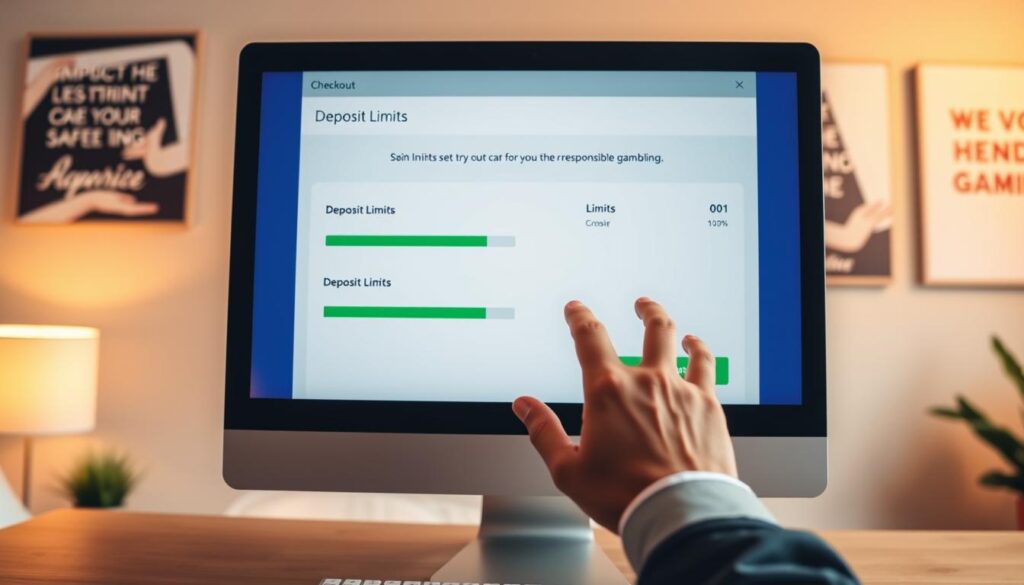
Behavioral economics teaches us a lot. Willpower is like a battery that runs out. The best time to set limits is when you’re about to deposit money. This way, you make a smart choice before you get caught up in the excitement.
Big sites like BetMGM remind you to set limits when you’re about to deposit. FanDuel and DraftKings do the same. These aren’t rules; they’re smart choices for players who know better.
Here’s what you can do:
- Deposit Limits: Set a max amount you can put in daily, weekly, or monthly. It’s like a budget for your fun.
- Loss Limits: Stop playing when you hit this number. No more playing after this point.
- Time Limits: Play for a set time. After 60 minutes, you’ll get a reminder to take a break.
- Cool-Off Periods: Take a break from gaming for a few hours to a few weeks. It’s like taking a break from your wallet.
Using these tools shows you’re smart, not weak. You’re playing within your limits, not chasing losses. The casino wants you to play until you’re tired or emotional. The smart player stops when they reach their limit.
Setting a $100 daily deposit limit changes how you see the game. Losing $20 is just 20% of your daily fun budget. You’re not trying to win; you’re enjoying your time.
Studies show players who use these responsible gambling tools are happier. They’re not winning more; they’re losing less stress. The worry of losing control goes away when you’ve set limits.
Set your limits first thing when you deposit. You’re clear-headed and haven’t seen any bad losses yet. This is a smart move. Set your limits and then forget about them. Let the system help you when you need it.
This is what makes playing fun, not a problem. The fun player sets rules before playing. The problem player hopes to stop when they should. Hope is not a plan; setting limits is.
So, when you’re about to deposit, take a moment. Setting a deposit limit is the smartest choice you’ll make. You’re not just playing; you’re making your own rules.
Red Flags: Unlicensed sites, crypto-only casinos, forced bonus opt-ins
The online casino world has its share of scams. Your first deposit should be for fun, not to fund a scam. Let’s look at three big warning signs.
Think of these red flags as a restaurant without a health grade. The food might look appealing, but it’s risky.
| Red Flag | What It Looks Like | Core Danger | Your Defense |
|---|---|---|---|
| Unlicensed Sites | Not listed on your state’s official gaming website. Vague “international licensing” claims. Headquarters in obscure offshore locations. | Zero consumer protection. Funds can vanish. Disputes are unresolved. Game fairness isn’t audited. | Check your state’s official regulator site before depositing. It’s your legal safety net. |
| Crypto-Only Casinos | Only accepts Bitcoin, Ethereum, etc. No traditional banking options. Often paired with anonymous accounts. | Hallmark of unregulated, offshore operations. Transactions are irreversible. No chargeback options. | Use crypto at licensed sites that also offer standard deposits. Never at crypto-exclusive shops. |
| Forced Bonus Opt-Ins | Can’t proceed to deposit without accepting a bonus. Bonus terms are buried. Wagering requirements are extreme. | Your money gets locked behind playthrough rules. Designed to keep you playing longer, losing more. | Always choose “No Bonus” if available. Read terms before depositing, not after. |
The Unlicensed Site: Gambling’s Wild West
An unlicensed site operates without oversight. It’s like a backroom game where the dealer owns the alley. Your deposit has no insurance policy here.
These operators answer to no regulator. If they decide your winning bet “violated terms,” you have no appeal process. Game outcomes? They could be as random as a fixed roulette wheel.
Always verify licensing. Your state’s gaming commission website is the single source of truth. If it’s not on their list, treat it like an email from a “Nigerian prince.”
Crypto-Only: The Anonymity Trap
Crypto-only casinos use digital currency’s cool factor to hide shady foundations. Crypto itself isn’t the problem. Its exclusive use by an operator usually is.
These platforms often operate from jurisdictions with lax laws. They value anonymity over accountability. Once your Bitcoin leaves your wallet, consider it gone. There’s no bank to call for a reversal.
Legitimate, regulated operators might offer crypto. They don’t require it. The absence of standard payment methods is a glaring warning sign.
The Bonus Shakedown
Forced bonus opt-ins are psychological warfare. The site makes the bonus acceptance box pre-checked and hard to decline. It’s a classic “dark pattern” in web design.
Why is this dangerous? Bonuses come with strings—massive wagering requirements. You might need to bet $5,000 before withdrawing a $100 bonus. Your own deposited cash gets tangled in these rules too.
It’s a trap designed to increase what the house calls “player action.” More bets mean more opportunities for the statistical edge to work against you. Always look for the “No Thank You” option. If it’s not there, reconsider the entire platform.
Spotting these red flags turns you from a victim to an informed consumer. Your money deserves a legitimate playground, not a rigged carnival game. Deposit with confidence, but only after you’ve done this basic detective work.
Quick Troubleshooting Flowchart
When your deposit hits a digital wall, don’t just rage-quit—think like a detective. That spinning wheel of doom isn’t personal. It’s a system sending you coded messages. Your job is to decrypt them.
This isn’t about blind panic. It’s about intellectual triage. Follow this mental flowchart, and you’ll transform frustration into a systematic troubleshooting mission. Consider it your first-aid kit for financial friction.
Start at the root: Deposit Failed. Now, ask the first diagnostic question. Did you receive a specific error message, or did the transaction simply vanish? This distinction matters more than you think.
An explicit error usually points to your bank or card issuer. The silent vanish often implicates the platform itself. Your investigation begins here.
| Symptom | Likely Cause | Immediate Action |
|---|---|---|
| “Transaction Declined” error | Address Verification System (AVS) mismatch, daily limit reached, or bank block. | 1. Verify billing info matches your bank records exactly. 2. Call your bank’s security line. 3. Check your personal deposit limits on the site. |
| Spins then nothing appears in balance | Small test deposit pending verification, or platform processing delay. | 1. Check your bank statement for a $0.50-$3.00 pending charge. 2. Wait 10-15 minutes. 3. Contact support with your username—not a rant, just facts. |
| Deposit button greyed out or unavailable | Personal deposit limit reached, KYC verification pending, or geographic restriction. | 1. Visit account settings to review your set limits. 2. Check your email for KYC document requests. 3. Confirm you’re in a permitted location. |
| Funds taken but bonus not applied | Accidental bonus opt-in with restrictive terms, or wagering requirement not met. | 1. Read the bonus terms—yes, actually read them. 2. Check your active promotions page. 3. Contact support to clarify bonus attachment. |
| All methods failing repeatedly | Account under security review, or systemic platform issue. | 1. Wait 24 hours for possible KYC clearance. 2. Try a different device or browser. 3. Escalate to support with transaction IDs. |
The table above is your cheat sheet. Think of it as a choose-your-own-adventure for grown-ups with money on the line. Each symptom leads to a logical cause, which points to a concrete action.
Notice a pattern? Contact support appears, but never as step one. Always gather your evidence first: username, transaction ID, screenshot of the error. Support agents aren’t mind readers. They’re database queriers.
The KYC hang-up deserves special mention. It’s the bureaucratic purgatory of online finance. If you’re stuck here, patience isn’t just a virtue—it’s the only tool that works. Resending the same document ten times won’t help.
Bonus complications are self-inflicted wounds 90% of the time. That shiny “CLAIM NOW” button is a siren call. Accepting a bonus without understanding its playthrough requirements is like signing a business plan without reading the fine print. Don’t do it.
When all else fails, simplify. Try a different payment method entirely. If PayPal failed, attempt a debit card. If card fails, test with a retail cash option like PayNearMe. This isolates whether the problem is method-specific or account-wide.
Remember: troubleshooting is systematic, not magical. There’s a reason for every failure. Your deposit isn’t lost in space. It’s trapped in a logical chain you can unravel. Approach it with curiosity, not fury.
You’ve now got the map. The maze of failed transactions just became navigable. Go forth and diagnose.
Printable First-Deposit Checklist
Think of this as your pre-flight checklist. You’ve learned the basics. Now it’s time to put it into action. This isn’t just about following rules. It’s about taking control and turning worries into action.
Print this page and grab a pen. Your task is to mark each box with precision. Begin by checking if your chosen platform, like DraftKings or FanDuel, is licensed in your state. This step is essential.
Next, turn on two-factor authentication. Have your driver’s license and a utility bill ready for verification. Choose your deposit method, noting its limits before you proceed.
Make a small test deposit to check the system. When you’re ready, set a personal deposit limit. Say no to bonuses that seem too good to be true. Save your transaction confirmation email for future reference.
Each checked box adds to your protection. This checklist is the summary of our guide. It’s a single page that keeps you safe from common issues. Keep it with you. You’re now ready to go.