
Let’s start with a confession. You’re probably a copyright owner and don’t even know it.
The days when the © symbol was rare are gone. A quiet revolution started in the late 1980s. Your original thoughts get legal protection the moment they’re written down.
Scholar James Boyle calls this our modern “enclosure movement.” Our vast commons of ideas are now fenced off. This isn’t about being mean. It’s just how things are.
As a scholar, you’re both the creator and the user. You make protected works and use others. This mix-up is at the core of intellectual property.
Knowing you own this automatically is key. It’s the foundation of every negotiation, every publication choice, and every claim to your intellectual legacy. It’s like learning the rules of a game you’ve been playing without seeing.
Understanding Publishing Contracts
You’ve spent a lot of time on your manuscript, only to face a legal document that seems scary. This isn’t just a formality. It’s about who owns your ideas. Your Academic Publishing Rights are real and specific, outlined in the contract.
The first contract type is a complete copyright transfer. It’s like selling your intellectual property. You get credit, but the publisher controls everything. You need their okay to share or use your work in any way.
The second option gives you a license back after transferring the deed. You get to use your work, but with rules. You can share online or in academic spaces, but not for profit. It’s a middle ground, but you’re not fully in control.
The third option is the most author-friendly. The publisher gets a license, but you keep the copyright. You’re in charge, letting them use your work in certain ways. This keeps your Academic Publishing Rights strong and flexible.
So, which contract did you sign? Many academics don’t know. The difference between being an author and a licensor is huge. These licensing agreements shape your scholarly impact.
Why is this important? Want to use your work in a course or translate it for a global event? With a full transfer, you need permission. With a license-back, you might have some rights. With retained copyright, you decide. The contract turns you from a creator to a contractual party.
The key is to understand the fine print and what rights you want to keep. Do you need to archive, share data, or build on your work? Start your negotiation with that list. Don’t let excitement cloud the terms. Your ideas deserve a fair deal.
Open Access vs Traditional Rights
Gold and Green Open Access are more than just ways to publish. They are fights over who gets to control knowledge. The old way, called “toll-access,” is like a never-ending loop. You work hard, give up your intellectual property rights, and then your university buys back your work from publishers. This system lets middlemen set prices and keep most of the money.
Open Access comes in to change this. It promises to end this cycle. But, it’s not just one thing. It’s a range with two main colors.
Gold Open Access makes your work free to read right away in an OA journal. You or your school pays a fee upfront. Green Open Access lets you put your work in a repository, like your school’s archive, after a wait. Both challenge the old paywall model but in different ways.
The real fight isn’t between Gold and Green. It’s between “libre” and “gratis.” Libre means free to use and share, like a recipe. Gratis means free to read, like a free beer. This fight is at the heart of the open movement.
On one side, CC-BY fans believe in the Creative Commons Attribution license. It lets anyone use your work as long as they give you credit. The other side, Share-Alike supporters, think copyleft protections (like CC-BY-SA) keep work open by stopping others from closing it down.
| Aspect | Gold Open Access | Green Open Access |
|---|---|---|
| Primary Method | Publication in OA journals | Self-archiving in repositories |
| Typical Cost | Article Processing Charges (APCs) | Usually free or minimal fees |
| Immediate Access | Yes, upon publication | Often after embargo period |
| Version Available | Final published version | Author’s accepted manuscript |
| Publisher Relationship | Direct partnership | Parallel publishing channel |
This debate is not just about words. It’s about power. CC-BY bets on the kindness of strangers. Share-Alike builds a shared space. Both aim to spread knowledge, but see different futures for research.
So, what’s at stake with your Academic Publishing Rights? Everything. Traditional publishing means giving up control. Open Access lets you take it back—but for what purpose? Are you letting companies profit from your work, or creating a space where knowledge flows freely?
Choosing between Gold and Green, libre and gratis, makes us question what we invite the world to do with our research. Can they copy it? Build on it? Sell it? The answer shapes not just your reputation but the whole world of knowledge.
Understanding intellectual property rights in academia is key. It’s not just about laws. It’s about politics and economics. Your choice today affects who can read, use, and control research tomorrow. That’s why knowing these differences is not optional—it’s essential for anyone who wants to make a difference.
Creative Commons Licensing Options
Understanding Creative Commons licenses is like making a legal pizza. You pick your favorite toppings, even if some are a bit tricky. This system is key for sharing work online. It makes copyright academic publishing flexible and easy to mix.
It’s like a peace treaty in the world of copyright. Instead of saying “all rights reserved,” you get to choose. This is very important for Academic Publishing Rights. It lets you decide how your work is used.
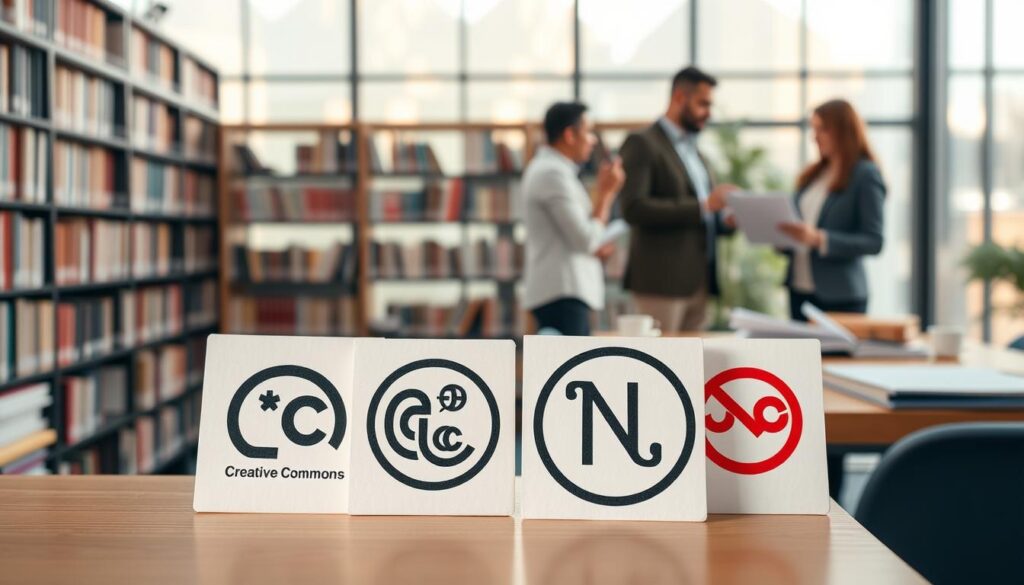
- Attribution (BY): This is the basic ingredient. Anyone using your work must give you credit. It’s a must-have for most CC licenses.
- ShareAlike (SA): This is the special sauce. If someone changes your work, they must share it under the same terms. It helps the community grow together.
- NonCommercial (NC): This is the favorite spice for many. It stops commercial use. Your work can be shared in class, but not for profit without your permission.
- NoDerivatives (ND): This is the gluten-free option. It lets you share but not change or build upon the work. Your work must be shared whole, not remixed.
By mixing these elements, you get different licenses. But not all are the same. The “Free Culture” movement supports only licenses that give four freedoms: to use, study, share, and improve works.
Here’s a quick guide on which licenses are okay and which aren’t:
| License Combination | Key Elements | Free Cultural Works Approved? | Interoperability Note |
|---|---|---|---|
| CC BY | Attribution only | Yes | Highly interoperable. The gold standard for open access. |
| CC BY-SA | Attribution + ShareAlike | Yes | Creates “copyleft.” New works must use same license, creating compatible families. |
| CC BY-NC | Attribution + NonCommercial | No | The “NC” clause is a major roadblock. It creates a non-commercial silo, incompatible with truly open projects. |
| CC BY-ND | Attribution + NoDerivatives | No | Prevents adaptation and remixing, stifling academic dialogue and derivative works like translations. |
| CC BY-NC-SA | Attribution + NonCommercial + ShareAlike | No | Double-whammy. Confines works to a non-commercial, share-alike ghetto with limited reuse. |
The NC and ND parts are like the spicy toppings. They seem safe but can cause problems. The NC part is popular in academia because it protects against commercial use.
But, to the Free Culture movement, it’s a problem. It makes it hard to share work widely. For example, an NC-licensed work can’t be used in Wikipedia, which uses CC BY-SA. This makes your work hard to share.
The ND part is also a problem. It stops others from improving or updating your work. In a world where we build on each other’s work, this limits progress.
Choosing the wrong license can limit your work’s reach. Your Academic Publishing Rights strategy should balance control with collaboration. Think about whether you’re building a bridge or a moat.
Before you choose a license, ask yourself: am I building a bridge or a moat? Your scholarly influence could depend on it.
Fair Use in Academic Context
Fair use in academia is not a magic solution. It’s more like a legal strategy you use when accused. It’s not a right you have, but a defense you raise after being accused.
Imagine saying, “I know I took it, but it’s okay.” Your success depends on a four-factor analysis. This is not magic; it’s a legal process. And the court is very skeptical.
| Factor | The Core Question | Academic Tilt |
|---|---|---|
| Purpose & Character | Is your use transformative or merely consumptive? | Criticism, parody, and teaching favor fair use. Straight copying for convenience does not. |
| Nature of the Work | Are you using factual material or creative expression? | Quoting from a research paper is safer than excerpting a novel. Published beats unpublished. |
| Amount & Substantiality | Did you take the heart or just a sliver? | Using a single chapter might be okay. Using the climax of a novel rarely is. Proportion is key. |
| Market Effect | Does your use usurp the original’s market? | The million-dollar question. If your copy replaces a sale, you lose. This factor often weighs heaviest. |
Some uses are clear wins. Writing a critique and quoting weak points? That’s transformative. Creating a parody for a lecture? Clearly fair use. These uses add new meaning or message.
Now, let’s enter the gray zone of academia. The controversy starts in the classroom and the digital archive.
Is uploading a book chapter to your Learning Management System fair use? Maybe. Factor one (teaching) helps. But if that chapter is the book’s core argument and the publisher sells a digital course pack, factor four (market effect) screams no. You just killed a possible sale.
What about compiling a course reader? The old “professor photocopy” routine. This is a classic battleground. Courts have ruled both ways. Taking small portions from many sources for face-to-face teaching often passes. But when it becomes a systematic, repeated replacement for textbooks, it fails. The market effect, again, rears its head.
Then there’s text and data mining. Copying entire corpora to find linguistic patterns. This is transformative research, arguing for factor one. But the “amount” taken is massive. The legal ground here is just starting to settle, like new scientific territory.
So, is fair use a shield or a sword? Primarily, it’s a shield. A big, heavy, expensive-to-lift shield. Using it is a calculated risk. You’re betting that your use ticks enough boxes to survive a challenge.
For many, navigating these Academic Publishing Rights murky waters is exhausting. Sometimes, seeking proper licensing agreements is the simpler, safer path. It’s the difference between hoping for an excuse and having a permission slip.
Understanding this defense is key for anyone managing Academic Publishing Rights. It empowers you to make informed choices. But never think a good argument means you’ll win. In the court of copyright, fair use is your closing statement, not your acquittal.
International Copyright Considerations
Imagine your research paper as a global citizen, welcomed in 195 countries but with 195 different rules. The internet was meant to be a place for free discussion, but intellectual property rights act as gatekeepers. They enforce their own rules, making your work digital but not always legal.
This isn’t just chaos. The Berne Convention sets a basic framework for copyright protection across many countries. It’s like a passport for your Academic Publishing Rights. But, each country can add its own rules, making things complicated.
While your work is recognized in places like Berlin, Tokyo, and Buenos Aires, what you can do varies a lot. The U.S. has a “fair use” doctrine, while the U.K. has “fair dealing.” Many countries have no similar rules. This makes simple actions like quoting or using images in lectures a big challenge.
The digital world makes these issues even harder. Let’s look at two examples:
- The Orphan Work Dilemma: You find the perfect photo or a key excerpt, but you can’t find the author. In the past, you might have taken a risk. Now, with the internet, the risk is much higher. There’s no global solution for these works, leaving them locked away.
- The First-Sale Doctrine Digital Illusion: This doctrine lets you share physical books. But does it apply to digital ones? Courts are unsure. When you buy a digital book, you’re often just licensing it. Sharing it might break the publisher’s intellectual property rights in many countries.
We built a global digital conversation on shaky legal ground. Your Academic Publishing Rights are both universal and local. To navigate this, you need to think globally, not just locally.
So, what’s the key takeaway? You must check where your work will be hosted and who will see it. Using a chart can help show the main problem:
| Concept | Global Principle (Berne) | National Reality | Digital Consequence |
|---|---|---|---|
| Protection | Automatic in member countries | Duration & formalities can differ | Your work is protected worldwide, but for varying lengths of time. |
| Exceptions | Allows for limitations | Defined nationally (e.g., Fair Use vs. Fair Dealing) | A lawful quote in the U.S. could be infringement in another country. |
| Ownership Transfer | Not specificially harmonized | First-sale doctrine applies to physical goods only in many places | Digital “lending” or resale exists in a legal gray zone across borders. |
The irony is thick enough to cut with a knife. We have the tech for a global republic of letters, but we’re stuck with a system of intellectual property rights from another era. Your strategy? Know the treaties, but respect the borders. When publishing online, assume your work will travel. Choose licenses and permissions that are understood worldwide. If unsure, seek permission for uses that might break a national rule. The goal is to be a savvy participant in the global market of ideas, not an international lawyer.
Rights Retention Strategies
Think of your publishing contract as a starting point for negotiation, not a final decree. It’s like playing intellectual property chess. The right move can secure your scholarly legacy. You don’t have to accept the publisher’s terms without a fight.
Your first move is the author addendum. It’s not just legal jargon; it’s a strategic tool. Groups like the Big Ten Academic Alliance have created model addenda. These addenda can change the game, allowing you to keep your work open and accessible.

- The Repository Right: This is your academic insurance policy. It ensures your work lives beyond the paywall, accessible to all.
- The Reuse Right: Why reinvent the wheel? Negotiate the ability to repurpose your charts and data in your next project.
- The Sharing Right: Your research should educate. Secure explicit permission to distribute copies in your classroom or at conferences.
But strategy requires knowing what you own before you give it away. Here’s where it gets murky. Is your article a “work made for hire” for your university? Many standard contracts assume so. Yet, the mythical “teacher exception” to copyright academic publishing—a common-law doctrine that might grant faculty ownership of scholarly works—
Don’t rely on myths. Check your university’s intellectual property policy. It’s the rulebook for this game. Some institutions actively support rights retention; others are vague. Knowing your own side’s position is half the battle.
The core tactic is simple: negotiate before you sign. Once the ink is dry, your leverage evaporates. Use the addendum. Clarify ownership. Retain the rights that fuel your academic mission. This isn’t about being difficult; it’s about being smart. In the long game of scholarship, controlling your own work isn’t just a victory—it’s the whole point.
License Negotiation Tactics
The publisher’s contract is like a hotel minibar offer. Everything can be changed if you know how. This isn’t a fight. It’s a smart talk where you start by saying you don’t agree with the publisher’s first offer. Your Academic Publishing Rights are what you start with, not what you give up.
Knowing about the three contract types gives you an edge. Your first step is simple. Just ask if you can change the agreement. Usually, the answer is yes. This opens the door for you.
What do you ask for? Use your scholarly purpose argument as your strongest tool. Explain why you need certain rights for your research and teaching. For example, you might say, “I need to share the accepted manuscript in my institutional repository to advance my research,” or “I want to include this chart in my course pack for my students.” You’re not being hard to please; you’re being an academic.
Here’s a simple script for your first email. It should be polite, professional, and clear.
- Subject: Amendment Request for Manuscript [Your MS Title]
- Body: “Thank you for the publishing agreement. I’d like to make a few changes for scholarly purposes. I want to keep the right to deposit the accepted manuscript in [Your University’s] open access repository after a 12-month wait. This fits with my university’s policy and will help the article reach more people. Can we make this change?”
The publisher might say no to your first request. This is where you find a middle ground. They might suggest a longer wait or a different version. Your goal is to keep what’s most important to you and find a compromise.
The most important advice is to Get. It. In. Writing. A promise from an editor isn’t enough. You need an email that says, “Yes, we agree to your changes,” to make it official. This email is your proof of agreement in your licensing agreements.
Save this email in three places. Attach it to the contract. This email is your protection. Negotiating your Academic Publishing Rights is about being a professional author who knows the value of their work. Your signature is powerful. Use it carefully.
Digital Rights Management
DRM is like a bouncer at a digital club. It checks your ID and lets you in if you’re allowed. But, owning digital content is just an illusion. You have a pass with many rules.
It’s all about code, not law. Creative Commons licenses give freedoms, but Digital Rights Management restricts them. It’s like a digital lock on your file. The code lets you read but not copy or print.
The Digital Millennium Copyright Act (DMCA) backs this up. It protects the DRM, even if it’s not right. Trying to bypass it, even for fair use, is illegal. It’s like a law for the lock, not what’s inside.
We’re in a digital Cold War. Open sharing and controlled access are at odds. This fight shapes Academic Publishing Rights. Your sharing rights can be controlled by software.
Can you ethically bypass DRM for fair use? The law says no, causing a big problem. A researcher might want to analyze DRM-protected texts for study. But, the law and technology clash.
Digital licenses vary greatly. The rules for software, genomic data, and articles are different.
| Content Type | Typical License/Restriction | Key Limitation for Academics | Open Alternative |
|---|---|---|---|
| Academic Journal (PDF) | Publisher DRM / All Rights Reserved | No text-mining, limited printing/sharing | Creative Commons BY or OA journal |
| Research Software/Code | Proprietary License or GNU GPL | Cannot modify or redistribute (proprietary) | MIT License, Apache 2.0 |
| Scientific Dataset | Custom Terms of Use | Restrictions on commercial use or redistribution | CC0 Public Domain Dedication |
| E-books (Monographs) | Adobe Digital Editions DRM | Expires with vendor, device limits | Open Access book with DRM-free PDF |
The table shows a clear picture. Your rights are set by technology, not contracts. You agree to rules that limit you.
For academics, being careful is key. Downloading articles might bind you to invisible rules. Fighting for intellectual property rights means knowing the law and the code.
DRM is a paradox in digital Academic Publishing Rights. It offers wide distribution but controls everything. Understanding this needs more than legal knowledge; it requires digital literacy and a keen eye for hidden details.
Legal Resources for Academics
You don’t need a law degree to understand scholarly communication. You just need the right tools. Think of it as protecting your ideas in the modern academy.
Your university’s copyright office or library team is a great place to start. They are experts in copyright and publishing. Don’t hesitate to ask them your questions.
Carry the SPARC Author Addendum with you. It helps you keep your publishing rights. Creative Commons licenses also offer easy ways to share your work.
For more information, check out the Copyright Resources Center online. Kylie Pappalardo’s book provides detailed guides on ownership, fair use, and open access. It’s a treasure trove of knowledge.
This is just the start of your journey to protect your work. Learning about copyright is key to owning your scholarly rights. Your ideas are valuable. Now you know how to protect them.