

The $1.5 billion Anthropic settlement gives academic authors a new reason to treat manuscript rights as part of the publishing process, not as paperwork handled after a book is finished. On July 20, 2026, U.S. District Judge Araceli Martínez-Olguín in San Francisco approved a class-action settlement requiring Anthropic to pay authors and publishers over claims tied to pirated books used to train Claude, the company’s AI chatbot. The deal covers more than 482,000 books, with eligible authors and publishers expected to receive about $3,000 per book.
For academic authors, the case is not only about a technology company. It is about how scholarly books, technical works, research monographs, and expert nonfiction can travel far beyond the author’s original publishing plan once digital copies exist. A manuscript that begins as a proposal, peer-reviewed draft, or published academic book may later become part of a licensing dispute, an AI training dataset, a rights claim, or a copyright record review.
That shift connects directly to the questions Interline Publishing has already raised around AI disclosure, fraud detection, and responsible manuscript preparation. The same care that applies to AI disclosure in academic publishing now applies to rights documentation. Authors need to know what they control, what they licensed, what the publisher controls, what permissions apply to included material, and what evidence they would need if a rights issue emerges later.
Why The Anthropic Settlement Matters Beyond Trade Publishing
The Anthropic case began in 2024 when authors Andrea Bartz, Charles Graeber, and Kirk Wallace Johnson sued Anthropic over the alleged use of copyrighted books in AI training. The Authors Guild describes Bartz v. Anthropic as one of the major author lawsuits challenging the use of books without permission to train large language models.
The settlement’s size is what makes it hard for academic authors to ignore. The Associated Press reported that the court-approved deal has been described as the largest copyright recovery in history, with 91% of covered works already claimed by eligible authors or publishers. That claim rate matters. It suggests that authors and rights holders were not treating the dispute as abstract policy. They saw enough connection between their works and the settlement process to file claims.
Academic publishing is not identical to commercial fiction or narrative nonfiction, but the rights problem is similar. Scholarly books often contain years of research, fieldwork, data interpretation, original theory, diagrams, archival references, interviews, technical explanation, and specialized terminology. AI systems that ingest large amounts of book text may be learning from the exact kind of expert structure that academic authors spend years building.
That does not mean every AI training dispute will end like Anthropic’s. It does mean that academic authors should stop treating rights management as a secondary concern. A dissertation-derived monograph, professional reference book, edited collection, or technical academic title can carry value far beyond its first sales cycle. The question is no longer only “Who will publish this book?” It is also “Who can use this text later, for what purpose, under which license, and with what record of consent?”
What The Case Did And Did Not Decide About AI Training
One reason the Anthropic settlement is so important is that it did not create a simple answer to every AI copyright question. AP reported that an earlier ruling found the use of copyrighted books to train AI was not automatically illegal, but Anthropic had improperly acquired content from pirate websites.
That distinction matters for authors. The case was not a blanket statement that every use of copyrighted books in model training is unlawful. It was a strong warning that how a company obtains the works, stores them, copies them, and uses them may affect the legal risk. For academic authors, that pushes the conversation toward documentation and licensing rather than slogans.
The U.S. Copyright Office has also treated AI training as a fact-specific issue. Its May 2025 report, Copyright and Artificial Intelligence Part 3, analyzes generative AI training and copyright questions in detail rather than offering a universal rule for every system, dataset, and use case.
For authors, the practical lesson is clear: keep records before a conflict exists. A published scholar may need to know whether a book was registered with the Copyright Office, whether rights were transferred or licensed, whether the publisher controls digital licensing, whether third-party images or excerpts were included, and whether the author retained any approval rights over future uses.
Academic authors often think about rights only when negotiating a contract. The Anthropic settlement shows why rights should remain visible after publication. A book’s publication date is not the end of its rights life. It may later appear in library databases, publisher platforms, indexing systems, archives, piracy repositories, AI training allegations, licensing negotiations, or settlement claim forms.
How Academic Authors Should Recheck Their Publishing Agreements
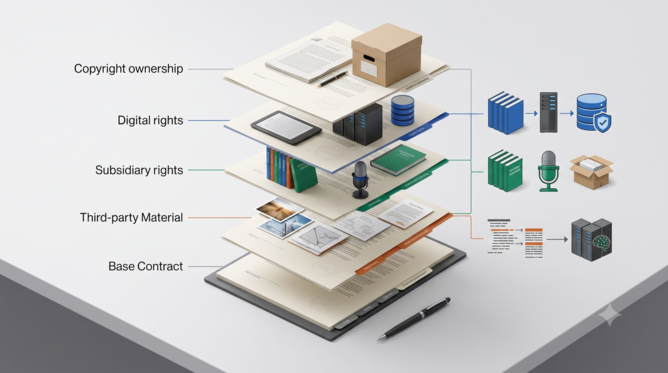
The first practical step for authors is to review the publishing agreement, not only the final book. Many academic contracts distinguish between copyright ownership, exclusive publishing rights, subsidiary rights, translation rights, electronic rights, audio rights, database rights, licensing rights, and permission to include material in digital products. Some agreements may use older language that never anticipated AI model training.
That does not automatically mean a contract is defective. It means authors should understand what the agreement says before assuming they control every future use. A university press, academic publisher, or scholarly imprint may hold certain licensing rights. An author may retain copyright but grant broad publication and distribution rights. An edited volume may involve separate contributor agreements. A book chapter may have different rights than a monograph.
The Anthropic settlement also intersects with active litigation elsewhere. On July 14, 2026, publishers including Hachette Book Group, Cengage Learning, and Elsevier, along with author Scott Turow, sued Google in federal court in New York, alleging that Google used copyrighted books to train Gemini without permission. That lawsuit raises questions about whether works originally provided for services such as Google Books or Google Play Books were used beyond the agreed scope.
For academic authors, that is a contract-reading issue. The critical question is not only whether a publisher can distribute a book. It is whether distribution, indexing, search access, digital storage, platform hosting, data licensing, or AI-related use is included in the rights language. Authors do not need to become lawyers to ask better questions, but they do need to recognize which parts of the agreement deserve careful review.
| Rights Area | Author Question | Why It Now Matters |
|---|---|---|
| Copyright Ownership | Does the author retain copyright or assign it? | Determines who may control later claims and permissions |
| Digital Rights | What electronic uses are licensed? | AI disputes often begin with digital copies and datasets |
| Subsidiary Rights | Who controls licensing beyond the first edition? | Future uses may involve platforms, excerpts, translations, or databases |
| Third-Party Material | Are images, excerpts, and data cleared for reuse? | Included material can create separate permission issues |
| AI Or Data Use | Does the contract mention machine learning, text mining, or automated analysis? | Older contracts may not address newer forms of exploitation |
This table is not legal advice. It is a planning tool for authors preparing to speak with a publisher, agent, rights advisor, university office, or attorney when needed.
Why Rights Documentation Is Becoming Part Of Author Readiness
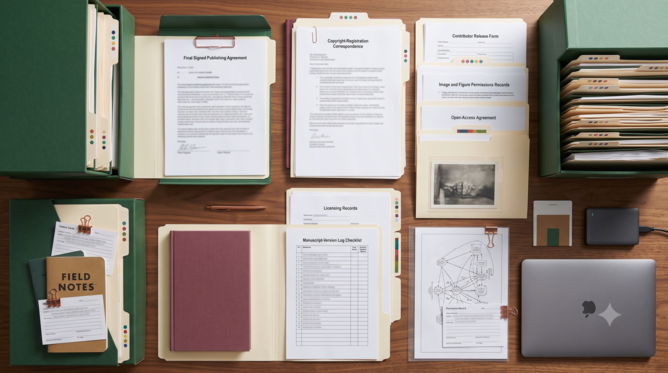
Academic authors already maintain research records. They keep citation files, ethics approvals, interview consent forms, figure permissions, data notes, peer review correspondence, and manuscript drafts. The Anthropic settlement suggests that rights records should be treated with the same seriousness.
A useful rights folder might include the final signed publishing agreement, copyright registration records where available, contributor agreements, permissions for reproduced material, image licenses, correspondence about open access terms, grant or funder requirements, and any statements about digital reuse. Authors of edited collections should keep contributor permission language organized, since each chapter may have its own author and rights history.
The Authors Guild’s settlement resources emphasize that Bartz v. Anthropic involved claims over books used without permission to train large language models. That framing matters for scholars whose books may sit at the intersection of professional knowledge and commercial AI value. Specialized content can be attractive precisely because it is structured, edited, and expert-reviewed.
Authors should also pay attention to manuscript security before publication. The Authors Guild maintains publishing scam alerts and reported on a July 2, 2026 update about rising email scams targeting authors. This belongs in the same rights conversation. If an unpublished manuscript is sent to an unknown party, uploaded into a weakly protected service, or shared outside a legitimate editorial workflow, the author may lose control long before the book reaches publication.
Rights readiness does not need to make the author paranoid. It should make the author organized. A scholar who can identify the contract, edition, publisher, publication date, permissions, registration status, and retained rights is in a stronger position than one who only has a PDF and a memory of the agreement.
How The Settlement Changes The AI Conversation For Scholarly Books

AI policy in academic publishing has often centered on disclosure: did the author use AI to draft, edit, translate, summarize, or prepare figures? That question still matters. The Anthropic settlement adds a second layer: was the author’s own work used to train AI, and if so, who had the right to permit that use?
Those two questions move in opposite directions. Submission disclosure asks authors to be transparent about their use of AI. Rights protection asks publishers, platforms, and technology companies to be transparent about their use of authors’ work. Academic authors need both standards to develop at the same time.
That is especially important for scholarly books. A research monograph may not sell at trade-book scale, but its value can be high in an AI training context. It may contain domain-specific explanation, technical language, disciplinary synthesis, and a carefully structured argument. A model trained on expert books may benefit from that labor even if the original audience was small.
This is why authors should ask publishers more direct questions about AI licensing. Does the press license book content to technology companies? Are authors notified before such licensing happens? Are royalties shared if content is licensed for AI training or large-scale text analysis? Are open access books treated differently from traditionally licensed books? Does the contract distinguish ordinary search indexing from machine learning ingestion?
These questions may not yet have clean answers across the industry. That is precisely why authors should ask them early. A proposal conversation, contract review, or rights negotiation is a better moment to raise AI use than a dispute years after publication.
What Authors Should Ask Before Signing The Next Contract
The next generation of academic book contracts will likely need clearer language around AI, text-and-data mining, platform reuse, and automated analysis. Authors do not need to reject every digital use. Search indexing, accessibility tools, preservation systems, scholarly databases, and discovery platforms can help readers find academic books. The key is to separate legitimate discoverability from broad, uncompensated exploitation.
A practical pre-signing review should focus on a few direct questions. Who owns the copyright? Who controls licensing beyond the first publication? Does the agreement mention AI, machine learning, text mining, training data, automated analysis, or data products? What happens if a technology company pays for access to the work? Will the author be notified? Will the author share revenue? Can the author opt out of certain uses?
Authors should also check whether the publisher’s public policy matches the contract language. A press may publish an AI policy, but the signed agreement controls the author relationship. If the policy changes later, the author needs to know whether the contract allows that change to affect existing works.
The Anthropic settlement is not a full map of AI copyright law. It is a warning light on the dashboard. It shows that book text has measurable value in AI systems and that unauthorized acquisition can carry major financial consequences. For academic authors, the best response is not to guess what courts will do next. It is to preserve records, read contracts more closely, ask rights questions early, and treat the book as intellectual property with a long digital life.
Why Scholarly Authors Need A Rights Strategy Before Publication
The $1.5 billion Anthropic settlement changes the rights conversation because it gives authors a concrete number, a real court, real plaintiffs, a real AI company, and a real claims process. It turns AI training from a vague industry concern into a publishing workflow issue.
Academic authors should take that seriously. A scholarly book is more than a credential or a contribution to the field. It is a rights-bearing work that can be licensed, copied, indexed, pirated, preserved, quoted, translated, excerpted, and potentially used in AI systems. That does not make publication riskier by itself. It makes unmanaged publication riskier.
The strongest author position begins before the contract is signed. Authors should know what they are giving away, what they are keeping, what the publisher can license, and how future technology uses are handled. They should keep clean records of permissions and final agreements. They should avoid sending manuscripts to questionable services or unknown contacts. They should ask publishers for plain answers about AI training and data licensing.
For academic authors, the rights conversation is now part of professional manuscript preparation. A strong book proposal explains the argument and the audience. A strong rights strategy explains ownership, permissions, licensing boundaries, and future-use questions. The Anthropic settlement shows why both belong in the same publishing plan.