

Navigating academic publishing funding is like trying to figure out a secret code. You know the big names like NSF and NIH, but the language is tricky.
This guide is your key to the back stage. We’re moving from soft suggestions to real money in research. It’s like a mix of a thriller and a survival guide.
The world is big. University subsidies are hidden in your library. Foundation grants offer a wider reach. Why do we need this money? The benefits are clear.
Open access isn’t just a trend. Studies, like those from Simon Fraser University, show it boosts your citation advantage. Your work gets seen, cited, and built upon quicker. It also increases your public impact, sharing your research with more people.
In today’s world of OA funds and mandates, your manuscript needs help. Let’s uncover who pays for the spotlight.
Where Money Lives: Internal Funds, Libraries, Departments, and Press Subventions
The most overlooked funding source for scholarly publishing isn’t a federal agency; it’s the office down the hall. Before you go begging at the gates of external fortresses, check your own castle’s treasury. The first rule of Grant Club is to exhaust internal options. Your university is more than a employer; it’s a possible first funder, hiding resources in plain sight.
Let’s start with the often-missed publication subventions. Your university press or faculty dean’s office might have a quiet pot of gold for this very purpose. It’s not advertised on a billboard. It’s the academic equivalent of a speakeasy—you need to know the password. A subvention can cover those critical last-mile costs, like specialized indexing or premium image reproduction, turning a good manuscript into a standout book.
Then, there’s the library. Forget the shushing stereotype. Modern libraries are publishing powerhouses. As the University of Victoria Libraries exemplify, they offer serious in-kind value that acts as a direct university subsidy for your work. This isn’t just IT support; it’s a subsidy wearing a cardigan.
Their services are the unsung heroes of discoverability. They can handle journal setup and hosting on platforms like Open Journal Systems (OJS) for free. They perform the digitization of back-issues, a godsend for edited volumes or legacy projects. Most importantly, they manage the alchemy of indexing and DOI creation, which transforms your work from a PDF in the void into a citable, findable piece of scholarship.
Don’t forget your department’s small, often nebulous budget for “scholarly activities.” That’s administrator code for “we can help with those pesky image permissions or a last-minute copyedit.” It might not fund your entire project, but it can be the financial duct tape that holds everything together at a critical moment.
| Internal Source | Typical Offerings | Key Advantage | Best For |
|---|---|---|---|
| Press / Dean’s Office (Subventions) | Direct cash grants for production, image rights, indexing | Directly reduces author’s out-of-pocket costs | Book projects, high-cost image permissions |
| University Library | In-kind hosting, digitization, DOI assignment, platform management | Significant university subsidies for infrastructure and visibility | Journal launches, digital projects, open access monographs |
| Academic Department | Discretionary funds for “scholarly activity” (editing, permissions, travel) | Fast, low-bureaucracy support for bridging gaps | Last-minute costs, conference fees related to publication |
| Faculty Research Office | Internal seed grants, workshop funding | Early-stage project development and collaboration building | Interdisciplinary volume planning, pilot studies |
The lesson is simple but profound. Your first major funder might be sitting in the office next door, sipping coffee from the departmental pot. Tapping into these internal streams of support, from direct publication subventions to the library’s technical largesse, doesn’t just save money. It builds institutional buy-in, turning your project from a solo mission into a shared endeavor. Start here. The outside world can wait.
External Sources: Federal Agencies, Foundations, Societies
External grants are the big leagues of scholarly publishing. Your pitch needs to be top-notch. You’re not just writing a book anymore. You’re changing the world.
In the U.S., the National Science Foundation (NSF) and the National Institutes of Health (NIH) are key players. They fund research and often cover costs like editing and open-access fees. In Canada, the Tri-Agency (NSERC, SSHRC, CIHR) does the same.
But, there are rules to follow. You must make your research open to everyone. We’ll explore this further. Federal grants can boost your work if you meet their requirements.
Private foundation grants are like the Medici families of today. They have specific goals. The Mellon Foundation supports humanities and digital publishing. The Wellcome Trust focuses on health research and open science.
Your proposal must match their goals perfectly. Applying for a grant from the wrong foundation is a big mistake.
Don’t forget about your field’s societies. They offer grants for books, collaborations, and translations. These grants are smaller, but the competition is less intense. The recognition in your field is huge.
The key is to align your project with the funder’s goals. A strategic approach to funding is essential for a successful scholarly career. It turns you into a partner, not just a seeker of support.
Budgeting for Interdisciplinary Projects (Editing, Figures, BPCs)
When you start spending grant money, you face a big challenge. It’s not just about the money; it’s about using it wisely without getting audited. Think of it like making a movie. Your budget is like a script, guiding your project to success.
Interdisciplinary projects can be costly, but in a good way. They’re like putting together a symposium in a book. Experts from different fields bring their own styles and ways of presenting data. Turning this into a cohesive book is a big task.
Visuals also play a big role. A graph for a sociologist might confuse an architect. Getting the right images or diagrams is key. Your budget should cover these costs.
Book processing charges (BPCs) are another big expense. Many top presses charge these fees for open-access books. This makes your book free for everyone to read, increasing its impact. Guides from the Tri-Agency and places like SFU say these costs are okay to fund.

Your budget tells a story about your project’s quality. Each item in your budget is a part of that story. Instead of just listing “Copy-editing: $3,500,” explain it. For example, “Funds professional harmonization of terminology and methodological presentation across six disciplinary traditions, ensuring intellectual rigor and reader accessibility for our target cross-disciplinary audience.”
| Budget Line Item | Typical Cost Range | The Narrative Justification |
|---|---|---|
| Specialized Copy-Editing | $2,500 – $5,000 | Ensures terminological consistency and argumentative clarity across contributing fields (e.g., legal theory, environmental science), upholding the scholarly rigor expected by all stakeholder communities. |
| Image/Figure Licensing & Creation | $1,000 – $4,000 | Covers rights for archival materials and funds original explanatory schematics, vital for translating complex, field-specific data into forms intelligible to the book’s broad, interdisciplinary readership. |
| Book Processing Charges (BPC) | $5,000 – $15,000 | Direct investment in global, barrier-free access, aligning with funder and institutional mandates for public impact. Transforms a publication into a public resource. |
| Indexing & Accessibility Formatting | $800 – $2,000 | Professional indexing is non-negotiable for a reference work spanning multiple disciplines. Accessibility formatting ensures compliance with equity policies and widens the audience. |
When you talk about book processing charges, you get to show your project’s impact. It’s not just a fee; it’s a way to make your research available worldwide. Funders want to see how their money changes things. Show them how this charge does that.
Managing all these expenses is a big job. You need to pay editors, designers, and presses on time. You also need to keep your manuscript on schedule. For tips on managing this, authors can check out how to master their editorial workflow.
In the end, a well-planned budget does more than avoid audits. It’s a strategic plan for your project. It shows the value of every collaboration, image, and dollar spent on open access. It’s your financial statement of ambition.
Building a Fundable Rationale and Audience Statement
The gap between a good idea and a funded project is bridged by a compelling rationale. This answers the funder’s silent question: ‘So what?’ Proposals either thrive or dive here. Saying your work is “important to the field” is like getting a participation trophy. It’s expected, bland, and gets you nowhere.
Your fundable rationale must be a killer argument, not just an observation. Think of it as the thesis statement for your funding campaign. Is your edited volume on Byzantine iconography a key to decoding modern political imagery? Does your data analysis on urban heat islands provide the missing link for city planners crafting climate resilience policy? You’re not just filling a literature gap; you’re building a conceptual bridge.
This bridge connects your scholarly contribution to tangible, real-world impact. Funders invest in change, not just footnotes. Your rationale must paint a vivid picture of that change. Will your work shift paradigms? Inform legislation? Redraw the boundaries of a discipline? That’s the ‘so what’ that gets checks signed.
Now, let’s talk guests. The audience statement is your project’s guest list. “Scholars in my field” is a non-starter. It’s like inviting “people who eat food” to a dinner party. Be ruthlessly specific.
Are you writing for advanced graduate students and policy analysts in federal agencies? Interdisciplinary scholars in digital humanities and museum curators? Name them. Quantify them if you can. This specificity shows you understand the ecosystem your work will live in. It proves you’ve thought about the conversation you’re starting, not just the book you’re finishing.
A powerful audience statement anticipates the ripple effects. It shows your monograph being debated in seminar rooms, cited in white papers on public health, and downloaded by engaged citizens worldwide. That’s a fundable vision.
To crystallize the difference between weak and strong, here’s a breakdown:
| Element | Common Pitfall (The Face-Plant) | Fundable Alternative (The Home Run) |
|---|---|---|
| Rationale Core | “This research is significant for historians.” | “This work decodes medieval legal rhetoric to provide a novel framework for analyzing contemporary political discourse, giving tools for journalists and ethicists.” |
| Audience Definition | “Academics and interested readers.” | “Upper-level undergraduate courses in political science; public policy think-tanks; and the legal history division of the American Historical Association (approx. 500 institutional members).” |
| Stated Impact | “It will contribute to the scholarship.” | “It will provide a transferable methodology for interdisciplinary teams studying propaganda, potentially influencing media literacy curricula in three key states.” |
Crafting this duo is more alchemy than accounting. Start with the ‘so what?’ and work backward. If your rationale doesn’t give you a slight jolt of excitement, it won’t move a jaded program officer. Ditch the jargon. Speak to the human consequence of your work.
For the audience, think beyond the usual suspects. Who is tangentially affected by your topic? Could your science text be a resource for science fiction writers? Could your literary analysis inform a theater director? These unexpected connections signal a project with legs—one that will travel and create value in multiple worlds.
Ultimately, you’re selling a conversation. Your rationale is the provocative opening statement. Your audience statement defines the brilliant, diverse room where that conversation will happen. Nail both, and funders won’t just fund your project. They’ll want a seat at the table.
Compliance and Funder Mandates (Data, OA, Public Access)
Funder mandates are like the fine print on a winning lottery ticket. You got the cash, but now you have to play by their rules. It’s not just about following rules; it’s about quality control. They’ve invested in your brilliance and want a return that includes bragging rights and maximum public impact.
Most major agencies, like the Tri-Agency in Canada, enforce strict Open Access policies. The main rule? Your final, peer-reviewed manuscript must be free for anyone to read within 12 months of publication. This is non-negotiable.
You have two main paths to follow: Green or Gold OA. This choice isn’t just philosophical; it’s a budgetary and strategic decision that directly involves your OA funds.
Let’s break down the duel. Green OA is the repository route. You publish in a traditional subscription journal and then deposit the accepted manuscript in a public archive, like your university’s institutional repository. Gold OA means paying the journal an Article Processing Charge (APC) upfront to make the final version immediately free on the publisher’s site.
Which path is right for you? The following table lays out the stark contrasts. Your OA funds are the financial engine for the Gold route, while Green demands more logistical legwork.
| Criteria | Green Open Access | Gold Open Access |
|---|---|---|
| Primary Cost | Typically low or none (repository fees may apply) | Article Processing Charge (APC), often $1,000-$5,000+ |
| Timeline to Public Access | Subject to publisher embargo (often 12 months) | Immediate upon publication |
| Version Available | Accepted manuscript (not the publisher’s PDF) | Final, typeset version of record |
| Funder Compliance | Meets mandate if embargo aligns | Meets mandate instantly |
| Budget Line Impact | Minimal direct cost | Directly draws from OA funds |
Here’s the kicker: your funding agreement likely requires you to acknowledge the grant with a specific Funding Reference Number (FRN). Forget this, and it’s like leaving the price tag on a gift. It’s their ROI metric, and omitting it is a cardinal sin.
Then there’s data. Increasingly, funders want a plan for your research data—how you’ll store, share, and preserve it. This isn’t an afterthought. It’s a core part of the research integrity they’re funding.
So, what happens if you ignore these mandates? Non-compliance isn’t a gentle reminder. It can trigger anything from withholding final grant payments to making you ineligible for future awards. They gave you the rope; don’t hang your career with it.
Ultimately, view these rules not as red tape but as a forced marketing strategy. The funder is insisting your work reaches the widest possible audience. That’s good for you, good for them, and good for the public that ultimately paid for it. Your OA funds and compliance checklist are the tools to make that happen. Use them wisely.
Crafting a Competitive Proposal: Aims, Methods, Timeline
A competitive proposal is more than asking for money. It’s a detailed plan that shows funders you can make your academic dreams real. It needs a mix of creativity and precision. Get this right, and you might just get the funding you need.
The Aims section is your chance to make a big impression. It’s what funders read first. It should be clear, bold, and exciting. Think of it like a movie trailer for your research.
Here, you explain how your project will make a difference. Will it change how we do research? Or bring together two fields? Be confident in your answer.
The Methods section shows you’re serious about your work. It’s the “how” part of your plan. You might use special methods or tools to get your work done. Be specific to avoid any doubts.
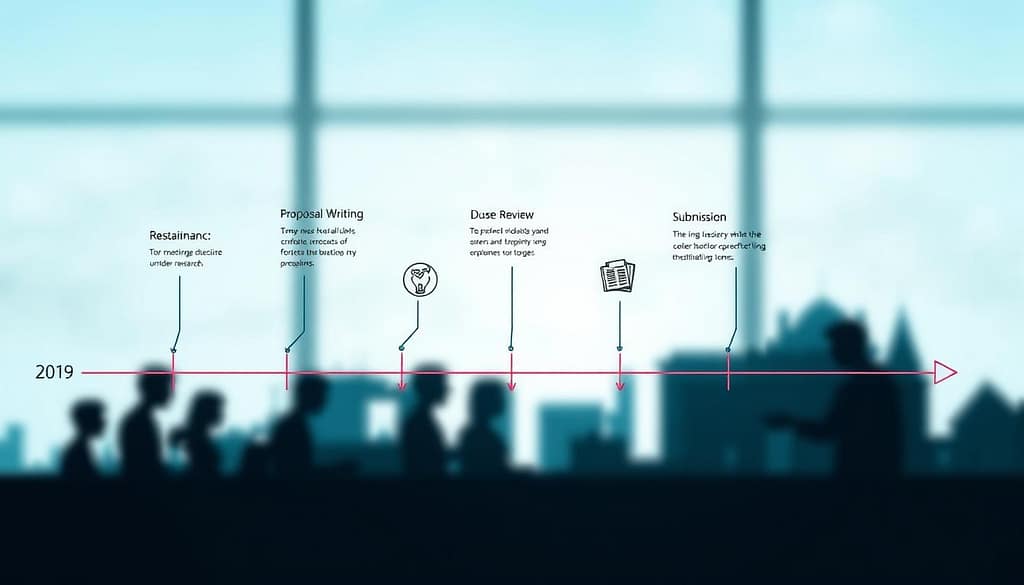
The Timeline is where you show you’re realistic. Be prepared for delays and changes. A good timeline shows you’re ready for challenges. It’s better to be safe than sorry.
Break down your project into smaller steps. Instead of saying “write the manuscript,” list all the tasks involved. This keeps everyone on track and shows funders you’re organized.
Consider a timeline like this:
| Phase | Key Task | Deliverable | Estimated Month |
|---|---|---|---|
| Project Initiation | Team assembly & contract signing | Signed agreements, project charter | Month 1 |
| Manuscript Development | Drafting chapters, collaborative editing | Complete first draft | Month 4 |
| Peer Review | Internal & external review cycles | Reviewer feedback report | Month 7 |
| Revisions | Incorporate feedback, final edits | Revised manuscript | Month 9 |
| Final Submission | Formatting, indexing, submission | Final manuscript to publisher | Month 12 |
Your proposal is like a personality test. The Aims show your goals. The Methods show your dedication. The Timeline shows your planning skills. A strong grant proposal tells a story that convinces funders to support you. Now, start writing like your career depends on it—because it does.
Sample Budget and Justification
Let’s talk about budgets. They’re where dreams meet reality. A good sample budget is like a story told in dollars. It shows you’ve thought about the real costs.
This document does two things. It lists what you need and explains why. The explanation part is key. It turns a simple list into a proof of your planning skills.
Break your budget into parts that funders like. Each part tells a part of your project’s story.
Personnel: This isn’t just about paying salaries. It’s about recognizing the work done. List the Principal Investigator’s summer salary and research assistant hours. Explain why, like “Summer salary lets us finish the manuscript without teaching delays.”
Travel: This is where funders check for waste. Budget for trips that help your project, like a workshop. Explain it clearly, like “We need to meet in person to work together.”
Materials & Supplies: This includes things like software and database access. Be specific, like “We need software for data analysis to ensure quality.”
Dissemination: This is about making your work public. It includes costs for open access and editing. Make sure these numbers are real.
Your justification should show you’ve done your homework. For example, “We’re spending $5,000 on editing to make sure it’s professional and on time.”
Here’s what a sample budget for a book might look like. The justification column is where you really show your work.
| Category | Item | Cost | Justification | Notes |
|---|---|---|---|---|
| Personnel | PI Summer Salary (1 month) | $8,500 | Provides dedicated time for final manuscript revisions and index preparation, ensuring timely submission to the press. | Based on institutional academic year salary rate. |
| Travel | Archive Research Trip | $1,200 | Essential for accessing unique primary source collections at the Library of Congress, a core component of chapters 3 and 4. | Includes airfare, lodging, and per diem at federal GSA rates. |
| Materials | Image Reproduction Rights | $750 | Licensing fees for 10 high-resolution images from museum archives, required for the visual analysis chapter. | Quotes obtained from each holding institution. |
| Dissemination | Book Processing Charge (BPC) | $7,500 | Open access fee to make the monograph freely available upon publication, aligning with funder public access mandates. | Quote from university press partner. |
| Dissemination | Professional Copy-Editing | $4,500 | Ensures grammatical precision, stylistic consistency, and adherence to Chicago Manual of Style across a 90,000-word manuscript. | Based on industry-standard rate of $0.05 per word. |
The table is more than just numbers. It shows you’re serious about your project. You’ve thought about every detail.
Remember, a detailed sample budget and justification say a lot. They show you’re responsible with money. This turns abstract funds into real pages. It’s the best twist in your grant proposal.
Grant Calendar and Application Workflow
Ever tried to bake a soufflé in a microwave? That’s what applying for a grant without a calendar feels like—a recipe for disaster. The process is a marathon run as a series of sprints, where thinking you can start a month before the deadline is a fantasy sold alongside Brooklyn real estate. To navigate this, you need a grant calendar. This isn’t a suggestion; it’s your survival blueprint.
The first non-negotiable entry? Your internal deadline. Most universities require a full review by their grants office, a process that typically needs to start two to three weeks before the funder’s final due date. Mark this date in bold, red ink. This is your true finish line. Everything else works backward from there.
So, what does this backward application workflow look like in practice? Let’s break it down. If your internal deadline is in Month 4, your planning begins in Month 1.
Month 1: The Blueprint. This is for thinking and drafting your core rationale and outline. Don’t write the full proposal yet. Just get the architecture of your argument on paper. What story are you telling the funder?
Month 2: The Commitments. Now, secure your letters of support or commitment. Reach out to co-authors, your publisher, and any collaborators. This step always takes longer than you think, as you’re at the mercy of other people’s inboxes.
Month 3: The Bloodbath. Send a full draft to your most trusted, brutally honest colleagues. Your goal here is not praise; it’s constructive massacre. Invite them to tear it apart. The feedback will be painful but priceless.
Month 4: The Polish. Incorporate that feedback, finalize your budget with the grants office, and proofread until your eyes cross. This is also when you submit for that internal review, leaving no room for last-minute technical glitches.
This entire sequence demands more than a to-do list. It requires real project management tools. A simple Gantt chart in software like Asana, Trello, or even a detailed spreadsheet works wonders. It visualizes dependencies—you can’t write the budget justification until the budget is done, after all.
Which brings us to a critical, often overlooked, tactic: delegate. You are the project manager and principal investigator. Can a research assistant gather the CVs for your team? Can a departmental admin help with formatting? Delegate these tasks. A chaotic application looks chaotic. A streamlined one looks professional, even if you’re frantically proofreading at 2 a.m.
The workflow is king. It transforms a panicked scramble into a managed process. You plan for the chaos. You own the timeline. And when that submission confirmation email pings, you’ll know the difference between a microwaved mess and a properly baked masterpiece.
Reporting, Closeout, and Post-Publication Amplification
The book is out. This is the final act, not the end. Your grant cycle needs a proper curtain call: reporting and amplification.
The final report to your funder is your receipt. It shows outcomes, expenses, and the link to your open-access publication. This isn’t just about following rules. It’s your proof of life.
Then, the spotlight shifts. Post-publication amplification is where you show your impact. Use leftover funds or support from your institution. Library marketing teams at places like UVic and SFU can help with hosting and making it easier to find.
Commission a sharp blog post. Record a podcast interview. Run targeted social media ads to reach academic circles. The grant built the ship. This campaign sets its course.
Remember the repository. As funders like the Tri-Agency say, depositing your final version in an archive is key. It ensures long-term access and survival, beyond any publisher’s website.
Your mission was never just to publish. It was to be heard. The grant gave you the manuscript. Your strategy gives it an echo.