

For authors and publishers, news website registration now has a more specific U.S. Copyright Office path than it did a few years ago. The Group Registration of Updates to a News Website, known as GRNW, gives qualifying publishers a way to register multiple updates from the same calendar month as one collective work. That sounds administrative, but it can affect editorial workflows, contributor agreements, rights tracking, and the way publishers document what appeared on a site on a given date.
Rohan Patel’s practical advice to emerging writers would be simple: do not treat copyright filing as a back-office issue that belongs only to the publisher. If your writing, photography, illustration, or editorial work appears on a news site, the registration path used by that site may not register your individual contribution in the way you assume. The GRNW option is useful, but it has limits.
How news website registration Works Under GRNW
What The Copyright Office Created
On July 22, 2024, the U.S. Copyright Office introduced the Group Registration of Updates to a News Website option. GRNW allows eligible publishers to register multiple updates made in the same calendar month as a single collective work rather than filing a separate application for each update. The Copyright Office explains this option on its GRNW registration page.
The Copyright Office later amended the rule. A final rule took effect on August 13, 2026, clarifying the definition of a “news website.” Under that amended rule, the site must be primarily designed to provide written information on current events, cover a broad range of subjects, be updated frequently, and function mainly as a reporting site. The Copyright Office announced the change in its final rule notice.
Why news website registration Is Not Article Registration
The key distinction is authorship level. GRNW covers the compilation-level authorship of the updates: the selection, coordination, and arrangement of material on the site. It does not require the Copyright Office to examine authorship or ownership of each article, photograph, graphic, or illustration included in those updates.
That distinction matters for freelancers and staff contributors. A publisher may be able to register the collective work, but that does not mean every individual contribution has been examined as a separate copyright claim through that application. Writers should ask what rights they are granting, whether the work is being treated as work made for hire, and whether any separate registration strategy is needed for their own material. This is not legal advice; it is a workflow warning that rights questions should be resolved before publication, not after a dispute.
Eligibility Rules Shape Editorial Planning
The Same-Month Rule Requires Clean Records
Under GRNW, the updates included in one application must have been published within the same calendar month. A March filing, for example, cannot bundle March updates with April updates. That rule creates a practical recordkeeping issue for editors and publishers: publication dates need to be reliable, and site updates need to be documented in a way that supports the filing.
The option also requires at least two published updates to a qualifying news website within the same calendar month. Each update must be a collective work, and the works must meet the Copyright Office’s requirements for authorship, originality, and fixed content. The research notes also indicate that the updates must be works made for hire where the claimant and author are the same entity.
Ownership Questions Cannot Be Left Vague
Eligibility also depends on ownership. The claimant must fully own copyright in the collective work and the contributions included. Contributions must not have been previously published or registered. If those conditions are not met, the Copyright Office may refuse the group registration application.
This is where editorial process and contract process meet. Publishers need contributor agreements that match the registration plan. Authors need to understand whether they are selling limited rights, granting broad rights, or producing work made for hire. If a publisher plans to rely on GRNW, uncertainty about contributor ownership can become a filing problem as well as a relationship problem.
For a closer related discussion, writers can review news website registration rules before assuming that a sitewide filing protects every individual piece in the same way.
Deposits And Proof Of Updates Matter
What Publishers Must Preserve
The deposit requirement is practical and easy to underestimate. For each date an update occurs in the month, the applicant must submit identifying material showing the homepage of the site at a specific point on that day. If the full homepage is too large or too variable, the first 25 pages may be accepted. Each update must be placed in a separate PDF and uploaded electronically.
That means GRNW is not only a legal filing path. It is also a documentation system. Editors, web producers, and rights managers need a repeatable process for capturing the homepage, naming files, storing PDFs, and connecting each deposit to the correct date. If a site changes throughout the day, the team should know which version is being preserved for registration purposes.
Why Editorial Teams Should Plan Before Filing
For publishers, news website registration should be built into the production calendar. Waiting until the end of the month to discover missing homepage captures, unclear publication dates, or unresolved contributor rights can make the application harder to support.
For authors, the lesson is different but connected. If your article appears in a frequently updated publication, ask how the publisher handles copyright records. Ask whether the publication treats your contribution as work made for hire or as licensed material. Ask whether the publisher expects to own all contributions for GRNW purposes. These questions are normal professional questions, not signs of mistrust.
Writers who hire editors, proofreaders, or publishing support should also keep their rights paperwork organized. Detailed insights from Top Ten Writing Services may assist writers in evaluating service options, although any copyright filing decision should be grounded in the actual publishing agreement and adherence to official Copyright Office requirements.
How Authors Can Protect Their Position
Ask Direct Questions Before Publication
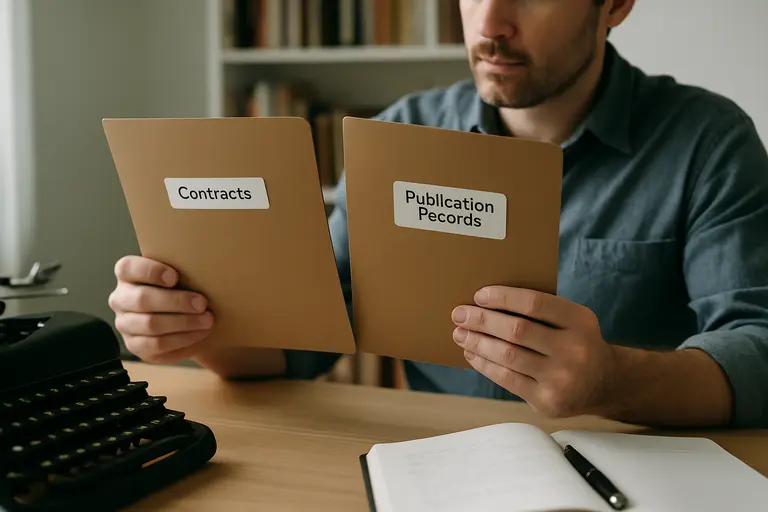
Emerging writers often focus on getting accepted, meeting deadlines, and polishing the piece. Those are real priorities. Still, rights terms should be read with the same care as editorial notes. Before publication, authors can ask whether the work is freelance licensed content, staff-created material, or work made for hire. They can also ask whether the publisher intends to include the update in a GRNW application.
Those questions help prevent a common misunderstanding: a sitewide or monthly registration may support the publisher’s collective-work claim, but it may not be a substitute for a separate registration of an individual article or image. The right approach depends on the agreement, the nature of the contribution, and the filing goal.
- Confirm who owns the contribution after publication.
- Keep signed agreements, assignment language, and invoices together.
- Save the publication date and URL for each contribution.
- Ask whether the publisher treats the update as part of a collective work.
- Use official Copyright Office guidance rather than informal assumptions.
Publishers Should Align Editorial And Rights Staff
Publishers benefit when editors, web teams, and rights staff use the same calendar. A qualifying news website registration filing depends on publication month, deposit material, claimant identity, ownership, and the type of work being registered. If each department tracks those details differently, mistakes become more likely.
Small publishers may not have a dedicated rights department. In that case, the process still needs an owner. Someone should verify that the site qualifies as a news website under the amended rule, that updates fall in the same month, that deposits are complete, and that contributor rights support the claim being made.
What GRNW Means For Authors And Publishers
GRNW gives qualifying news publishers a more fitting registration route for frequently updated websites than filing separately for every changing version of a site. That is its practical strength. It responds to a real publishing problem: news sites can change often, and daily changes can be hard to register one by one.
Its limit is just as important. The option concerns collective-work registration for qualifying updates. It does not erase the need for clear contributor agreements, accurate publication records, and careful treatment of individual articles, photos, and illustrations. Authors should not assume that a publisher’s GRNW filing protects their personal rights in the same way a separate filing might. Publishers should not assume that a monthly group application can fix unclear ownership after the fact.
The best editorial process treats news website registration as part of publication planning. Before the update goes live, the team should know who owns what, what will be captured for the deposit, which month the update belongs to, and whether the site fits the Copyright Office definition. That preparation protects the working relationship as much as the filing. Clear rights language, reliable records, and honest communication give both authors and publishers a stronger foundation for publishing news online.