

Writing an academic book that bridges mechanical engineering, immunology, and pure mathematics is already a monumental feat. At Interline Publishing, we know that disseminating that complex knowledge shouldn’t be derailed by administrative hurdles. Unfortunately, a major regulatory collision has just occurred in the federal funding landscape, and it directly affects how university scholars will pay for Open Access (OA) publishing moving forward.
On May 29, 2026, the White House Office of Management and Budget (OMB) issued a proposed overhaul of federal grant rules. This proposal threatens to turn the already confusing world of Book Processing Charges (BPCs) and Article Processing Charges (APCs) upside down, putting interdisciplinary scholars caught in the crossfire of conflicting federal mandates.
Here is a straightforward breakdown of the current funding clash, how it impacts your publishing strategy, and the steps you need to take before the changes take effect.
The Core Conflict: OMB §200.461 vs. The Nelson Memo
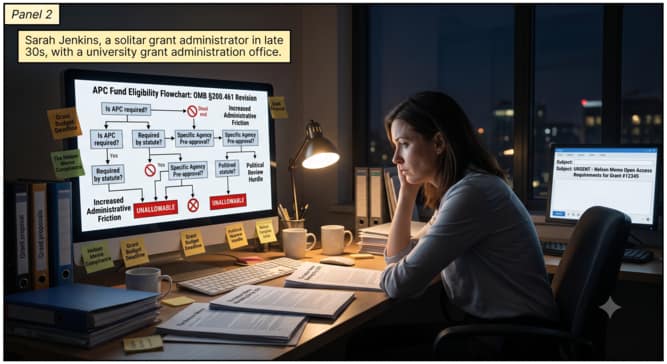
The root of the issue lies in a direct contradiction between two major pieces of federal policy.
For years, the research community has been preparing for the full implementation of the White House Office of Science and Technology Policy’s (OSTP) “Nelson Memo.“ This mandate dictates that starting in 2026, all federally funded research must be made freely and immediately available to the public without paywalls or embargoes.
However, the OMB’s newly proposed revision to the Uniform Guidance—specifically 2 C.F.R. §200.461—effectively cuts off the primary funding pathway researchers use to comply with the Nelson Memo.
The Big Change: Under the proposed rewrite, publication costs (including APCs, open access fees, and page charges) will transition from being “generally allowable” to categorically unallowable by default. Grant dollars cannot be used to pay these fees unless the funding agency specifically pre-approves them on a case-by-case basis.
Comparing the Grant Rule Landscape

To understand the severity of the shift, let’s look at the data and regulatory changes:
| Regulatory Aspect | Current Uniform Guidance | Proposed OMB Rewrite (May 29, 2026) |
| Default Status of Publication Costs | Generally allowable if the publication reports on federally funded research. | Unallowable unless required by statute or explicitly pre-approved by the agency. |
| Budgeting Flexibility | Modest publication fees could often be absorbed or reallocated from general supplies. | Reallocating funds for publication costs without prior approval will likely trigger audit findings. |
| Political Review | Rely heavily on scientific peer review for grant management. | Introduces pre-issuance review by senior political appointees for discretionary awards. |
| Implementation Date | Currently Active | Proposed to take effect October 1, 2026. |
What This Means for Interdisciplinary Scholars
If you are a university scholar preparing to publish a cross-disciplinary monograph or edited volume, this policy clash introduces several immediate operational hurdles:
- Long-Term Budget Forecasting: Post-award publication choices now become rigid budget decisions made years before the manuscript is finished. If you anticipate submitting to an Open Access platform or a hybrid journal, you must explicitly outline those exact BPCs or APCs in your initial grant proposal. Upgrading your venue later will leave you with an unfunded gap.
- The Threat to Multi-Year Projects: Interdisciplinary work often relies on multi-year grants. Because the proposed OMB rules could allow agencies to terminate or restrict federal grant awards at their discretion—with heightened scrutiny on specific types of research—funding for the final publication phase of a multi-year project is no longer guaranteed.
- Increased Administrative Friction: Navigating peer review across disciplines is tough; navigating multiple federal agencies to get a $3,000 to $10,000 publication line item approved by a political appointee is tougher.
Actionable Steps to Take Before October 2026

The OMB has opened the floor for public feedback, and the clock is ticking. The deadline to submit substantive public comments is July 13, 2026, with the rules slated to take effect at the start of the 2027 Fiscal Year (October 1, 2026).
Here is what you and your institution should do immediately:
- Audit In-Flight Grant Applications: Review every NIH, NSF, DOE, or other federal proposal currently in your pipeline that has an anticipated award date after October 1, 2026. If publication costs are not explicitly enumerated as a line item, work with your grant office to add them now.
- Submit Specific Public Comments: Generic complaints will be ignored. Work with your university’s scholarly communication officers to submit comments to Regulations.gov explicitly detailing the operational impossibility of complying with the OSTP Nelson Memo while operating under the proposed §200.461 restrictions.
- Leverage the Federal Purpose License (FPL): If grant funds are cut off from paying author-side fees, you will need to rely heavily on the FPL to deposit accepted manuscripts into agency repositories without paying commercial publisher fees.
- Check Institutional Agreements: Ensure your university’s “read-and-publish” transformative agreements with major publishers specifically classify institutional payments as subscription costs rather than individual publication costs to avoid falling under the new §200.461 prior-approval net.
At Interline Publishing, we remain committed to supporting our authors through these turbulent funding shifts. Rigorous, interdisciplinary scholarship is essential to solving society’s biggest challenges, and we will continue to advocate for clear, accessible pathways to academic