The journey from a brilliant idea to a finished academic book is often described as a winding road. Scholars and researchers find it hard to see the full path from start to finish.
Knowing the complete publishing timeline is key. It helps you plan your work and manage expectations. This process usually takes 9 to 18 months, sometimes longer.
For most academic authors, the journey starts with a talk with an acquisitions editor at a university press. Then, a series of stages follows.
These stages include pre-contract development, the core manuscript and peer review cycle, and the detailed production process. Marketing efforts also build up to your pub date.
This guide offers a clear roadmap. It makes each step clear, from your initial pitch to holding both the printed and digital editions of your work.
High‑Level Roadmap (typical 9–18 months)
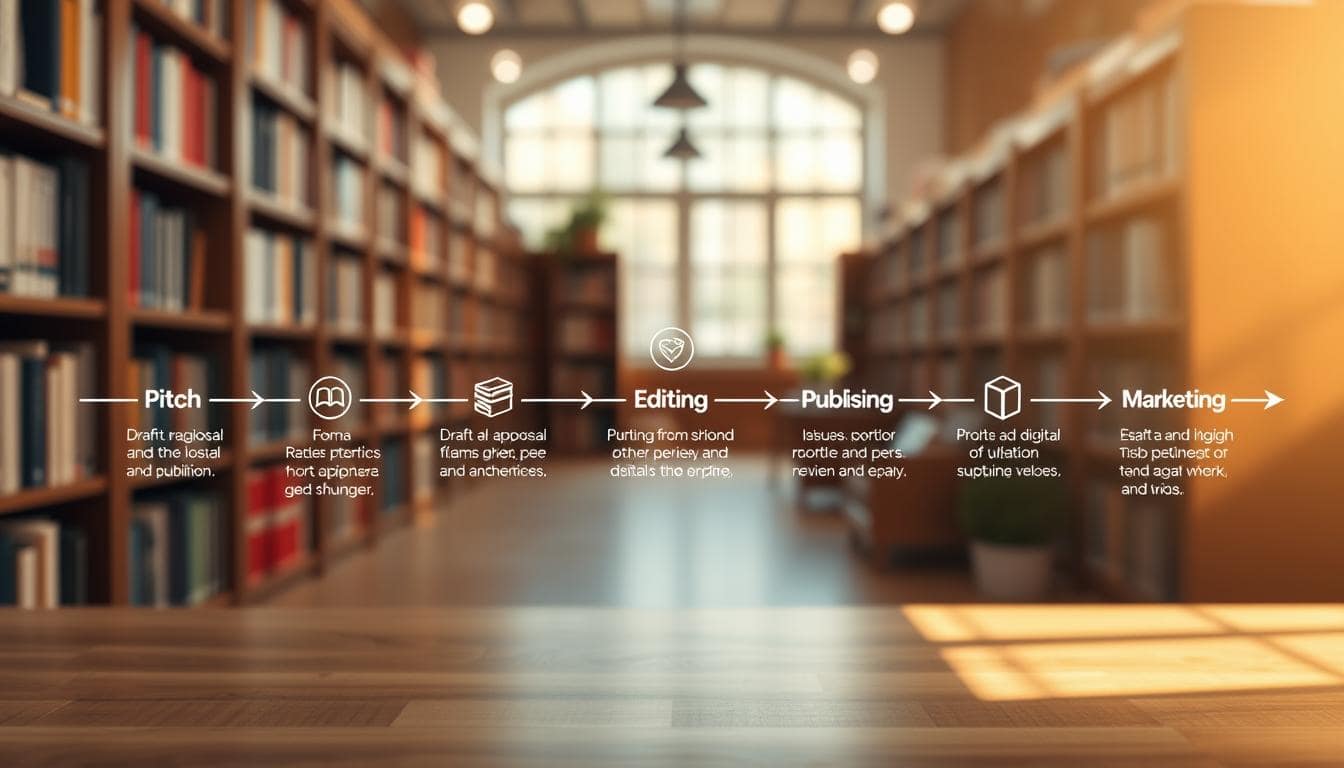
A high-level roadmap for academic publishing shows a flexible yet structured timeline. It usually takes 9 to 18 months from the first contact to the printed book. Remember, every process is unique.
This journey is not a straight line. It’s a team effort. Teams from acquisitions, editorial, production, and marketing work together from the start.
The process is divided into four main parts:
- Acquisitions & Proposal: Initial contact, proposal development, and internal board approvals.
- Manuscript Development: Writing, peer review, and author revisions.
- Production: Copyediting, typesetting, proofreading, and indexing.
- Marketing & Launch: Building awareness before and after publication.
The acquisitions phase is where you start. You work with an editor to make your book idea strong. This proposal then goes to the press’s board for approval. This stage can take several months.
After approval, you enter the manuscript revision period. This can take up to 18 months. You’ll go through many drafts based on feedback from your editor and peer reviewers.
Then, the production pipeline starts. This includes copyediting, art checks, typesetting, and proof review. Production and marketing planning add another 6 to 12 months to the timeline.
Your press’s marketing team plans early. They build campaigns while the book is being edited. This ensures a strong launch when the book is released.
Knowing this roadmap helps you set realistic expectations. It prepares you for the team effort needed to publish your book.
Pre‑Contract: proposal, sample, board approval
Your book’s credibility and market fit are checked in the pre-contract phase. This includes submitting a proposal, peer review, and board approval. It’s a critical step to see if your project will move forward.
The first contact is usually with an acquisitions editor. This editor supports your project within the publishing house. They check if your project fits the publisher’s list, its audience, and its field contribution.
A compelling book proposal is your main tool at this stage. It must make a strong case for your project. A good proposal addresses both scholarly and commercial aspects.
| Component | Description | Primary Purpose |
|---|---|---|
| Overview & Thesis | A brief summary of the book’s main argument, scope, and unique contribution. | To grab the editor’s interest and highlight the project’s intellectual value. |
| Chapter Summaries | Detailed abstracts for each chapter, showing the book’s structure and flow. | To show a well-planned manuscript and confirm the project’s feasibility. |
| Sample Chapters | 1-2 polished, complete chapters that show your writing and research quality. | To give a concrete example of your style, depth, and ability to execute the idea. |
| Comparative Titles | An analysis of competing and complementary books, explaining your unique contribution. | To prove market awareness and show there’s a space for your book. |
| Author Bio & CV | Your professional credentials, previous publications, and relevant expertise. | To establish your authority and credibility as the book’s author. |
After submitting your proposal and samples, the peer review begins. The editor will send your work to 2-3 external experts in your field. This is key to academic publishing.
The reviewers give anonymous reports on your work’s originality, accuracy, and significance. They may suggest acceptance, revision, or rejection. A positive peer review is vital for your book’s credibility.
When you get reader reports, you need to respond strategically. Address all critiques thoughtfully. A detailed revision plan showing how you’ll incorporate feedback strengthens your position. See this as a collaborative step to improve your work.
The last hurdle is internal committee approval. Publishing acquisitions are a “decision by committee.” The editor presents your project, along with the external reviews and a detailed Profit & Loss (P&L) analysis, to an editorial committee or faculty board.
This board looks at the whole picture. They consider the scholarly reviews, the projected sales, and the project’s alignment with the press’s mission. Their formal vote grants the editor permission to offer you a contract. Success here moves your project from proposal to contracted work.
Contract to Manuscript: delivery schedule, permissions, art program
Getting from contract to manuscript is all about schedules, permissions, and artwork. This stage turns your project into something real. Your publisher’s editorial associate is your key contact. Keeping in touch with them is key.
Your signed contract is your guide. It sets your manuscript deadline. Missing this deadline can push back your book’s release by months.
Take your delivery schedule seriously. Set personal deadlines a few weeks before the official one. This gives you time for unexpected delays. Talk to your editorial associate early if you face any issues.

Getting permissions is a big task. You need written consent for any third-party material. This includes quotes, poems, and images you didn’t create. Start this process as soon as you sign your contract.
- Identify all third-party material: Make a list of each item, source, copyright holder, and page number.
- Research rights holders: For books, contact the publisher. For journals, use the publisher’s rights department website. For images, find the artist, museum, or stock agency.
- Request permission early: It can take 4-12 weeks. Be ready to pay fees, like for commercial images or music lyrics.
- Keep impeccable records: Save every email and signed form. Your publisher will need these with your final manuscript.
Without permissions, you might have to rewrite or replace images. This can mess up your whole schedule. Plan for both time and money for this step.
While getting permissions, work on your art program. This includes figures, charts, graphs, and photos. Publishers have strict rules for these. Sending low-quality images or wrong formats can delay production.
Here’s what to do for your artwork:
- Resolution: Use vector files (e.g., .eps, .svg) or high-resolution .png files (minimum 300 DPI) for charts and graphs.
- Photographs: Use original, high-quality files, not screenshots from websites.
- Labeling: Number all figures consecutively (Figure 1.1, 1.2). Provide a separate document with detailed captions and source credits.
- Accessibility: Make sure charts have enough color contrast and that all information in a graph is also described in the caption or main text.
Your editorial associate will give you the publisher’s specific art guidelines. Read them before creating or reformatting any images. Do not embed images directly in your Word document. Send them as separate, properly named files.
Going from contract to manuscript is a test of project management. Stick to the schedule, get permissions fast, and prepare artwork correctly. This builds trust with your publisher. Regular updates with your editorial associate can avoid big problems. This careful approach helps your work move smoothly into peer review.
Peer Review & Revision Loop
After you submit your manuscript, it goes into the peer review and revision phase. This is a team effort to make your arguments stronger and your evidence clearer before it’s accepted.
Reviewer feedback can be detailed. Start by seeing their comments as a chance to make your book better. Think of them as a way to improve your work’s clarity and impact.
Here are some tips to make revisions easier:
- Categorize comments by type: major conceptual, minor clarifications, and simple corrections.
- Draft a detailed response letter for your editor. Acknowledge each point and explain your revisions.
- For complex suggestions, revise in focused sessions. Tackle one chapter or theme at a time.
Substantive revision focuses on the “what” of your argument. Then, copyediting refines the “how” you present it.
A copy editor is your last check before typesetting. They make sure your text is ready for readers. Their job is to polish, not change the core of your work.
The copy editor does several important tasks:
- Polishing prose for better flow, rhythm, and readability without changing your voice.
- Ensuring a consistent style (like Chicago or APA) for citations, punctuation, and terminology.
- Checking for unclear passages or contradictions directly in the manuscript.
- Fact-checking names, dates, titles, and URLs for accuracy.
When you get the copyedited manuscript, it’s important to review it carefully. You’ll see queries and suggested changes. Go through each one thoughtfully.
Mostly, accept the stylistic corrections. For big questions, give clear answers in the margins. This ensures your final message is clear. Learning to streamline the journal peer review process helps with book revisions too.
This whole process, from peer review to copyediting, makes your work better. Your manuscript is now ready for typesetting and design.
Production: copyediting, art checks, typesetting, proof review, indexing, cover design
Once your manuscript is accepted, it moves into production. The publisher’s team handles a series of tasks to turn your text into a finished book.
First, a copy editor checks your manuscript. They look for grammar, consistency, and style issues. They make sure it follows the publisher’s style guide, like Chicago or APA.
At the same time, the art program is completed. The team checks figures, tables, and images. They ensure everything is correct before the book is typeset.
Typesetting is when the book’s design is applied. The typesetter uses software to create page layouts. They choose fonts, set margins, and place all elements.
This process turns your manuscript into a professional-looking book. It’s ready for printing.

Next, you get the page proofs. These are PDFs of the typeset pages. You need to review them for any errors introduced during formatting.
This is not the time for big changes. You’re looking for typographical mistakes only. Mark any corrections clearly on the PDF. The publisher’s proofreader will also check the proofs independently.
While you review proofs, the index is being made. An index is key for scholarly books. You can do it yourself or hire a professional indexer.
A professional indexer reads the proofs and finds important concepts, names, and terms. They create a detailed, cross-referenced index. This makes your book more useful and professional.
Cover design happens on a separate track. The publisher’s design team creates concepts based on your book’s topic and market. While you might provide input, the final decision is theirs.
A good cover is important for both print and digital. It must look great online and on a shelf.
| Production Role | Primary Responsibility | Key Deliverable |
|---|---|---|
| Copy Editor | Polishes grammar, style, and consistency. | Clean, styled manuscript file. |
| Typesetter/Designer | Applies interior layout and page design. | Page proofs (PDFs) of the typeset book. |
| Proofreader | Reviews page proofs for formatting and typographical errors. | A corrected set of proofs for finalization. |
| Indexer | Creates a detailed subject and name index. | Final index file for insertion into the book. |
The production phase is a team effort. Each professional plays a specific part in building your book. Clear communication and meeting your deadlines keep this complex process on track.
Metadata & ISBNs: ONIX, keywords, BISAC/Thema
While you’re making your manuscript perfect, another important task starts. This is creating the metadata that helps people find your book. Think of metadata as your book’s digital fingerprint. It’s the info that tells the world about your book.
This info includes the title, author, description, page count, and price. But it also includes subject codes and keywords. Good metadata helps libraries, online stores, and search engines find and show your book to readers.
ONIX (ONline Information eXchange) is how we share this info. It’s a standard format for publishers to share book details with others. A full ONIX feed makes sure your book’s info is the same everywhere.
For help on making great ONIX data, check out the OCLC advice for ONIX providers. It’s key for making sure your data meets library standards.
Subject classifications are very important. In the U.S., we use BISAC (Book Industry Standards and Communications). Internationally, Thema is often used.
Choosing the right BISAC or Thema codes is not just a formality. These codes help guide your book to the right spot in a virtual bookstore. Picking codes that match your book’s content and audience is key for people to find it.
Keywords are also important. They’re the terms people might search for. Your keywords should be specific and cover:
- Central themes and concepts
- Key methodologies or theories
- Geographic or historical focus
- Primary audience (e.g., graduate students, policymakers)
Getting your metadata ready is tied to two big steps: getting ISBNs and setting your pub date. An ISBN is a unique number for each book format (hardcover, paperback, e-book). Your publisher usually gives these out.
Your pub date is when your book officially comes out. It’s set during a “launch meeting” after the final manuscript is ready. This date starts pre-orders and helps with marketing.
In short, good metadata helps people find your book online. It links your ISBN to search terms and makes sure your book shows up when people are looking. Spending time on this behind-the-scenes data is a smart move for your book’s success.
Launch Week & Post‑Pub Maintenance
Launch week is the peak of your publishing journey. It’s when you push hard on social media, host events, and reach out to media. Your publisher’s team will put their marketing plans into action.
After the book is out, the work continues. You’ll work with your promotions manager on publicity. You’ll also keep an eye on sales and ask for reviews in journals.
Make sure your website and CV show off your book. Look into translation rights and other opportunities. Keeping up with your book helps it stay relevant. Learn more about managing your work by checking out project management strategies for academic workflows.
A book’s real journey starts when it’s published. Your ongoing support is essential for its success.