
Submitting your manuscript to the wrong journal is one of the most common — and avoidable — causes of delay in academic publishing.
A strong study can be rejected not because it lacks merit, but because it doesn’t align with a journal’s scope, readership, or editorial priorities. Choosing the right journal is not a matter of prestige alone. It is a strategic decision that directly affects visibility, citation potential, review time, and long-term scholarly impact.
Selecting the right outlet requires analytical thinking — the same rigor you applied to your research design.
Start With Scope, Not Status
The first filter should never be impact factor.
Begin with journal scope alignment. Carefully read the journal’s aims and scope statement. Examine recently published articles. Ask:
- Does my research topic clearly fit within their thematic focus?
- Does my methodology align with what they typically publish?
- Is the theoretical framing consistent with their disciplinary perspective?
Editors conduct an initial screening before sending manuscripts to reviewers. If your article feels tangential to the journal’s mission, it may face a desk rejection regardless of quality.
If you are unfamiliar with editorial screening criteria, our guide to responding to peer review comments strategically explains what editors evaluate early in the process.
Alignment is foundational. Prestige is secondary.
Understand the Journal’s Audience
Every journal speaks to a specific community.
Some target highly specialized scholars. Others prioritize interdisciplinary readership. Some publish practice-oriented research with applied implications. Others emphasize theoretical advancement.
Ask yourself:
- Who do I want reading this work?
- Where will my contribution have the most intellectual influence?
- Which community is most likely to cite it?
Publishing in a top-ranked journal outside your core audience may reduce practical impact. Conversely, a well-aligned field journal can generate stronger engagement.
A manuscript’s value increases when it reaches the readers who need it most.
Evaluate Impact Metrics With Context
Impact factor, CiteScore, and other bibliometric indicators are useful — but they require interpretation.
High impact factor journals often have:
- Lower acceptance rates
- Longer review cycles
- Broader international visibility
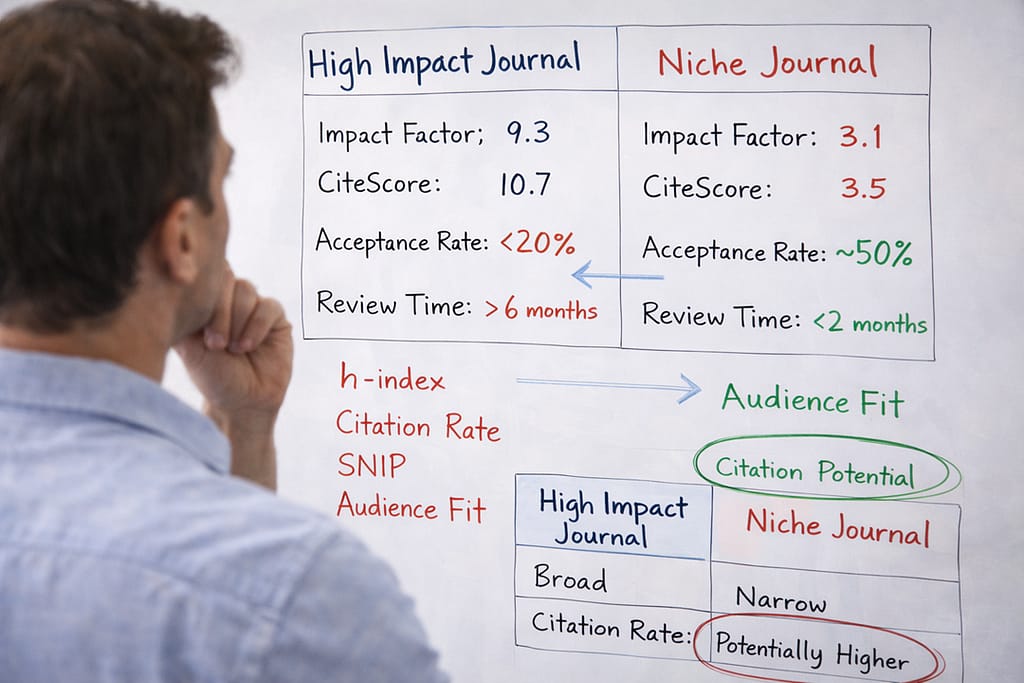
However, mid-tier or specialized journals may offer:
- Faster turnaround
- Stronger niche authority
- Higher readership relevance
Here is a simplified comparison framework:
| Factor | High-Impact Journal | Specialized/Niche Journal |
|---|---|---|
| Acceptance Rate | Low | Moderate |
| Review Time | Often Longer | Often Shorter |
| Audience Reach | Broad | Targeted |
| Citation Potential | High (if accepted) | Strong within niche |
| Competition Level | Very High | Moderate |
Impact metrics should support your strategy — not define it.
If your research introduces a breakthrough or wide-scale policy implication, aiming high may be justified. If your study advances a focused theoretical debate, alignment may outweigh numerical ranking.
Assess Review and Publication Timelines
Timing matters, particularly for early-career scholars or grant-funded research.
Some journals publish average review times on their websites. Others require investigation through editorial reports or colleague experience.
Consider:
- Average time to first decision
- Number of review rounds typical
- Time from acceptance to publication
- Online first publication policies
If tenure review or funding deadlines are approaching, a two-year publication cycle may not be viable.
Strategic timing can be as important as placement prestige.
Consider Open Access Versus Traditional Publishing
The rise of open access has reshaped journal selection decisions.
Open access journals often provide:
- Wider immediate visibility
- Compliance with funding mandates
- Increased accessibility outside academia
Traditional subscription journals may offer:
- Established reputation
- Strong archival presence
- Lower upfront costs (if no APC required)
Evaluate:
- Article processing charges (APCs)
- Institutional open access agreements
- Funder requirements
Choosing between open access and traditional publication is not ideological — it is strategic.
If formatting or structural requirements differ significantly between outlets, reviewing technical manuscript preparation best practices before submission can prevent unnecessary revisions.
Examine Editorial Board and Peer Review Culture
Editorial leadership influences journal direction.
Review:
- The editor-in-chief’s research profile
- The diversity and expertise of the editorial board
- Geographic and institutional representation
A board composed of scholars aligned with your theoretical framework may signal intellectual compatibility.
Additionally, examine whether the journal uses Double-blind peer review, Single-blind review or Open peer review.
Understanding review culture prepares you for what to expect post-submission.
Analyze Acceptance Patterns and Article Types
Study the types of articles the journal favors.
Do they publish:
- Empirical studies only?
- Conceptual papers?
- Systematic reviews?
- Methodological notes?
- Policy briefs?
Your manuscript type must match their editorial mix.
Reading three to five recent issues provides more insight than relying solely on the website description.
Patterns matter.
Avoid Predatory or Questionable Journals
Due diligence is essential.
Warning signs may include:
- Unrealistically rapid acceptance promises
- Lack of transparent peer review process
- Unclear editorial affiliations
- Excessive APCs without reputation

Consult recognized indexing databases (e.g., Scopus, Web of Science, DOAJ) and confirm inclusion status.
Journal selection is an academic investment. Protect it accordingly.
Develop a Tiered Submission Strategy
Most experienced scholars create a ranked list:
- Primary target journal
- Secondary alternative
- Tertiary fallback option
This reduces decision fatigue in case of rejection.
Each journal on your list should fit your topic, match your methodology and serve your intended audience for success.
Strategic planning prevents reactive submissions after rejection.
Match Your Contribution to the Journal’s Identity
The strongest submissions clearly reflect a journal’s intellectual identity.
Review mission statements for recurring themes such as:
- Innovation
- Policy relevance
- Methodological rigor
- Theoretical advancement
- Interdisciplinary integration
Then ensure your introduction and conclusion emphasize how your work contributes to those themes.
Choosing the right journal is not only about fit — it is about framing.
The Strategic Perspective
Journal selection is a research decision.
It requires evaluating alignment, audience, timing, impact, and scholarly positioning. When approached strategically, this decision increases publication probability and long-term influence.
The right journal amplifies your argument.
The wrong one delays it.
Approach this step with the same analytical discipline you apply to your data — and your work will find the audience it deserves.