
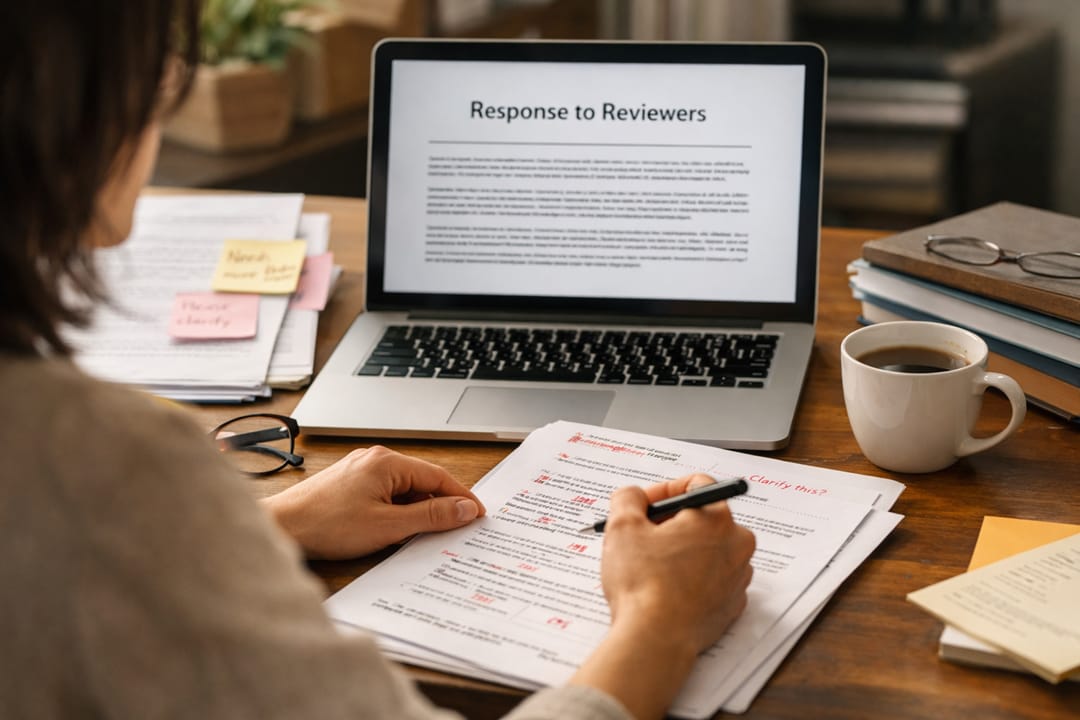
You open the email. The subject line reads: Decision on Your Manuscript.
Your pulse quickens. You scan the first paragraph. It’s not a rejection — but it’s not an acceptance either. It’s “Revise and Resubmit.”
Then you scroll.
Pages of reviewer comments.
Some are thoughtful. Some are confusing. A few feel… sharp.
Now comes the real test — not just improving your manuscript, but responding in a way that strengthens your work without weakening your authority.
Responding to peer review is a professional skill. Done well, it improves clarity, rigor, and publication odds. Done poorly, it can unintentionally cast doubt on your research.
Let’s walk through how to handle reviewer feedback strategically, calmly, and convincingly.
First, Reframe the Situation
Before drafting a single response, shift your mindset.
Peer review is not an attack. It is a quality control mechanism designed to ensure clarity, validity, and contribution to the field. Even blunt feedback often reflects a reader struggling with interpretation — and that’s useful information.
If you need context on how the review process works, our guide to understanding the academic peer review journey explains what editors and reviewers are evaluating at each stage.
The goal now is not to “win.” It’s to demonstrate intellectual maturity and methodological confidence.
Step One: Separate Emotion from Evaluation
It’s normal to react emotionally at first. Take 24–48 hours before responding.
Then reread the comments and categorize them:
- Major methodological concerns
- Requests for clarification
- Literature expansion suggestions
- Minor stylistic edits
- Misunderstandings of your argument
This separation prevents defensive responses and helps you prioritize effectively.
Often, what feels like criticism of your competence is actually a clarity issue in the manuscript.
Step Two: Create a Structured Response Document
Editors expect a clear, organized response letter.
The gold standard approach is:
- Copy each reviewer comment verbatim.
- Respond directly below it.
- Indicate precisely where revisions were made (page and paragraph numbers).
Clarity here signals professionalism.
For example:
Reviewer Comment 2: “The sampling criteria are unclear.”
Response: Thank you for highlighting this point. We have clarified the sampling framework on page 7, paragraph 2, specifying inclusion and exclusion criteria and recruitment procedures.
Notice the tone: neutral, appreciative, specific.
Never write:
- “The reviewer misunderstood.”
- “This was already clear.”
- “We disagree” (without explanation).
Instead, write:
“We respectfully clarify…” or
“We have expanded this section to better explain…”
Professional language protects your credibility.
When You Agree with the Reviewer
Agreement is straightforward — but still strategic.
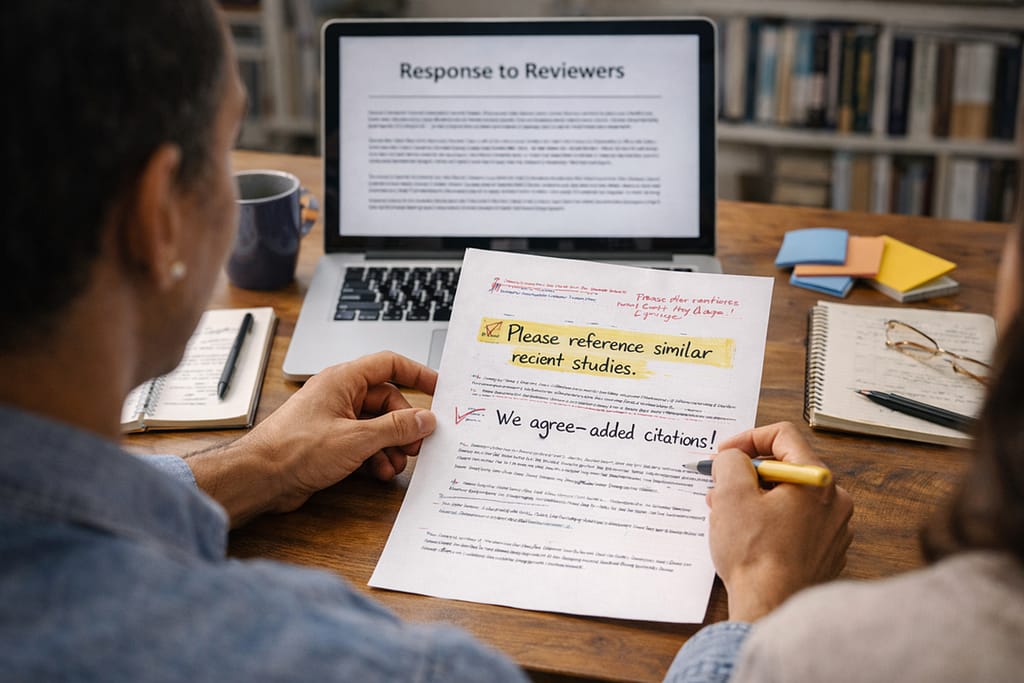
If a reviewer identifies a gap, acknowledge it clearly:
“We appreciate this insight and have expanded the theoretical framework to incorporate recent literature (pages 4–5).”
Avoid over-apologizing. You are improving the manuscript, not admitting incompetence.
When You Disagree (Without Undermining Yourself)
Disagreement must be handled with precision.
First, evaluate whether the reviewer is pointing to a legitimate ambiguity. Often, revising for clarity resolves the issue.
If you truly disagree:
- Acknowledge the reviewer’s perspective.
- Provide justification grounded in methodology or literature.
- Offer clarification in the manuscript.
Example:
“We appreciate this perspective. However, our methodological approach aligns with established practice in [Field X] (Smith, 2020; Patel, 2022). To clarify this rationale, we have added explanatory text on page 9.”
This shows confidence supported by evidence — not defensiveness.
If you are unsure whether to push back, our article on choosing the right academic format for your research goals discusses how disciplinary norms shape reviewer expectations.
Handling Conflicting Reviewer Comments
This is one of the most common challenges.
If Reviewer A suggests expanding a section and Reviewer B suggests trimming it, do not choose blindly.
Instead:
- Follow the editor’s guidance if provided.
- Prioritize clarity and contribution.
- Explain your decision transparently.
Example:
“While Reviewer A recommended expanding Section 3 and Reviewer B suggested condensing it, we have streamlined redundant material while clarifying the core argument to balance both concerns.”
Editors appreciate balanced reasoning.
Avoiding the Most Common Mistakes
Even strong scholars make these response errors:
1. Defensive Tone
Subtle sarcasm or dismissiveness damages credibility.
2. Vague Responses
Saying “Revised as suggested” without explanation frustrates editors.
3. Overcorrection
Adding excessive material to appease every suggestion can dilute your argument.
4. Silent Disagreement
Ignoring a comment entirely signals carelessness.
If a comment is unclear, you may respectfully state:
“We interpreted this comment as referring to X. If this interpretation is incorrect, we welcome further clarification.”
Professional humility strengthens your position.
Use Revisions to Strengthen — Not Dilute — Your Argument

Some authors weaken their manuscript during revision by:
- Softening strong claims unnecessarily
- Adding hedging language everywhere
- Overloading the literature review defensively
Instead, revise strategically.
Ask:
- Does this change improve clarity?
- Does it strengthen evidence?
- Does it sharpen my contribution?
Peer review should refine your argument — not erase its distinctiveness.
If you are still preparing your submission materials, our guide to preparing your manuscript like a pro outlines technical best practices that reduce reviewer friction from the start.
Final Review Before Resubmission
Before sending your revision:
- Re-read the full manuscript for coherence.
- Ensure new additions integrate smoothly.
- Double-check that all reviewer comments are addressed.
- Maintain consistent tone and terminology.
Your response letter should reflect:
- Professionalism
- Precision
- Confidence
- Collegial respect
The Bigger Picture
Responding to peer review is part of scholarly development. The strongest researchers are not those who avoid criticism — but those who integrate feedback without compromising intellectual integrity.
Handled correctly, reviewer comments become a collaboration rather than a confrontation.
Your revision is not just a corrected manuscript.
It is evidence of your scholarly maturity.