

Moving your cash shouldn’t be like a spy thriller. You shouldn’t wonder if the drop will happen.
You’re fed up with hidden costs, vague timelines, and worries about data safety. This is your briefing. We’re diving deep into the money-moving world.
This isn’t just a list. It’s a guide to protect your money. Think of me as your financial sherpa, with a twist.
We’re looking at the pros and cons of different methods. Ready to move money like a pro, not a victim?
Let’s get into the details.
Picking a Method That Fits Your Needs (Speed vs Privacy vs Budget)
The payment method you choose says a lot about you. It shows what matters most to you: speed, privacy, or saving money. It’s like choosing between three important things.
If you want your money to arrive quickly, you might have to pay more. This could be in cash or by sharing your personal info. If you’re on a tight budget, expect slower transactions.
This isn’t just about moving money. It’s about what you value most in your finances. Do you want things done fast, or do you prioritize keeping your info private?
Let’s look at the three main values that shape every transaction decision.
The Need for Speed
Speed lovers want their money now. They’re impatient and willing to pay extra for quick service. This often means higher fees and sharing more personal data.
Digital wallets and card payments are usually the fastest. But, traditional bank transfers are much slower.
The Privacy Principle
Privacy seekers don’t want their data tracked. They prefer cash or digital options that keep their info private. But, these might be slower and cost more.
The trade-off is slower processing and possibly higher costs. This is for services that protect your online privacy.
The Budget Battle
Those who watch their spending closely will wait for a deal. They prefer free ACH transfers, even if they take longer. This saves them money.
The downside is slower access and less privacy. Budget-friendly options often require more data sharing.
To see these trade-offs clearly, here’s a method comparison table:
| Priority Style | Speed Rating | Privacy Level | Cost Impact | Best For Users Who… |
|---|---|---|---|---|
| The Speed Demon | Instant to 1 hour | Low to Medium | High fees (3-5%) | Value time over money, need immediate access |
| The Privacy Purist | 1-3 business days | High | Medium fees (1-3%) | Protect personal data above all else |
| The Budget Ninja | 3-5 business days | Medium | Low to no fees | Optimize every dollar, can wait for funds |
| The Balanced Broker | 1-2 business days | Medium to High | Minimal fees (0-1%) | Seek reasonable compromise on all fronts |
This method comparison table is like a financial personality test. It shows where you stand. Most of us switch between these categories based on the situation.
For example, you might be a Speed Demon for urgent needs but a Budget Ninja for regular expenses.
Banks used to be safe but expensive. Now, apps offer convenience but with limits. The choice depends on your needs.
Understanding your priorities helps you navigate the financial world better. You’ll see why some services cost more and why others take longer.
This section is like choosing your battlefield before the fight. The next part will give you the details you need. But first, you need to know what you’re willing to give up.
Your perfect method comparison table balances what you want with what you’re willing to pay. Now, let’s look at the actual methods in this financial battle.
Deep Dive Pros/Cons: ACH/eCheck, Debit Card, PayPal/Venmo, Apple/Google Pay, Play+, PayNearMe, Cash at Cage, Wire/Check
If payment methods were characters in a heist movie, each would have a very specific role—and trust me, not all of them make it to the final getaway car. This payment methods comparison isn’t about dry specifications. It’s about personality, quirks, and hidden agendas.
Think of ACH as the Honda Civic of finance. It gets you from point A to point B without fanfare. The pros are straightforward: it’s often free and directly connected to your bank account. No middleman skimming profits.
The cons? It’s the slowpoke of the group. That “3-5 business days” window feels like watching paint dry in the digital age. It’s also traceable—your bank knows exactly what you’re funding.
Debit Card: The Eager Intern
Your debit card is instantly available and hungry to please. The connection is direct, and transactions are usually processed within minutes. It’s convenient, familiar, and widely accepted.
Here’s the catch: that eager intern takes a cut. Processor fees (often hidden in the exchange rate or as small charges) are the norm. Plus, it’s a chatterbox—your bank gets a full report of every transaction.
PayPal & Venmo: The Popular Crowd
Everyone’s on these platforms. They’re fast, convenient, and feel social. The transfer speed is often near-instant, and the user interface is designed for simplicity.
But the popular kids gossip. Your transaction history isn’t private. Fees can appear for certain transactions, and they’re also gatekeepers—if they don’t like your activity, your account gets frozen.
Apple Pay & Google Pay: The Tech Savants
These are the sleek, minimalist options. They prioritize security with tokenization and biometric locks. The experience feels futuristic—just tap your phone.
The limitation? They’re not universal. You need compatible devices and merchants. They’re also layers on top of other payment methods, not independent networks. Think of them as very stylish middlemen.
Play+: The Branded Gift Card
Play+ functions like a digital, reloadable gift card specific to gaming platforms. The appeal is control—you load a set amount and can’t overspend. It creates a psychological spending barrier.
The downside is obvious: it’s limited to specific ecosystems. You’re also dealing with yet another account to manage. The funds are trapped within that branded universe.
PayNearMe: The Analog Bridge
This is a fascinating hybrid. You generate a barcode online, then pay cash at a convenience store like 7-Eleven. It’s perfect for the unbanked or privacy-conscious.
The trade-off? You have to physically go somewhere. There’s often a fee (the store’s cut), and it’s not instant—the cash needs to be processed. It’s convenience store convenience, not digital convenience.
Cash at Cage: The Retro Experience
Walking up to a physical cage and handing over bills feels like a scene from Casino. The pros are visceral: complete anonymity, immediate confirmation, and no digital trail.
The cons are equally visceral: carrying large amounts of cash is risky. There’s no electronic record for disputes. It also requires physical proximity to a “cage”—not an option for digital natives.
Wire Transfers & Checks: The Old Guard
Wires are the Formula 1 cars of money movement—blazing fast but expensive. They’re reliable for large amounts and international transfers. Checks are their opposite: painfully slow but creating a paper trail some prefer.
Wire fees can be shockingly high. Checks might bounce, and the clearing time is measured in geological epochs. Both methods feel increasingly anachronistic in a tap-to-pay world.
| Method | Speed | Typical Fees | Privacy Level |
|---|---|---|---|
| ACH/eCheck | Slow (3-5 days) | Often Free | Low (Bank sees all) |
| Debit Card | Fast (Minutes) | Processor Fees | Low |
| PayPal/Venmo | Very Fast | Variable Fees | Medium |
| Apple/Google Pay | Instant | Depends on Backend | High (Tokenized) |
| Play+ | Fast | Possible Load Fees | Medium |
| PayNearMe | Delayed | Convenience Fee | High (Cash-based) |
| Cash at Cage | Instant | None | Very High |
| Wire Transfer | Very Fast | High ($20-50) | Medium |
| Check | Very Slow | Bank Fees Possible | Low (Paper trail) |
This payment methods comparison reveals a fundamental truth: every option makes trade-offs. Speed costs privacy. Convenience costs fees. Anonymity costs security. There’s no perfect solution—only the right tool for your specific job.
The digital intern (debit card) will gossip about you. The reliable workhorse (ACH) will make you wait. The popular apps (PayPal) will take their cut. Your choice in this financial ecosystem depends entirely on what you value most in the moment.
Speed Benchmarks (Realistic Windows)
In the world of online finance, “instant” is just a myth. It’s like calling fries “gourmet” in a restaurant. The promise is everywhere, but the wait is always long.
This isn’t about what marketing says. It’s about what really happens. When will your money actually move? We’re setting realistic expectations so you’re not stuck refreshing your app all day.
Let’s look at the real race against time. For deposits, it’s often ACH vs PayPal. PayPal and similar services update your balance fast. It feels like magic.
But, ACH or eCheck pulls from your bank are slow. They take 1 to 3 business days. Even overnight, a Friday deposit might not clear until Monday.
So, for adding money to your account, digital wallets are the winners. But things change when you try to take money out.
| Method | Deposit Speed (Realistic) | Withdrawal Speed (Realistic) |
|---|---|---|
| PayPal/Venmo | Seconds to Minutes | 24-48 Hours to Linked Bank |
| ACH / eCheck | 1-3 Business Days | 1-3 Business Days |
| Debit/Credit Card | Seconds | Not Typically Available |
| Bank Wire | Same Day (Domestic) | 1 Business Day (Domestic) |
| Cash at Cage/PayNearMe | Minutes to Hours | Immediate (Cash Pickup) |
Withdrawals are different. The ACH vs PayPal story changes. That quick deposit was just a loan. Getting your winnings back takes a day or two with PayPal. ACH withdrawals are just as slow.
Cash is the fastest option. Services like PayNearMe or a casino cage offer cash in minutes to hours. It’s a return to the old ways in the digital age.
International transfers are even slower. Wires can take 1 to 5 days, depending on time zones and banks.
The lesson? “Instant” is just a feeling. Plan based on the slowest reliable time, not the fastest promise. Your blood pressure will appreciate it.
Fees & Hidden Costs (processor fees, bank charges)
Welcome to the financial funhouse where every mirror distorts the true cost of your transaction. The advertised fee is just the ticket price. The real expense waits inside, wearing a clever disguise.
Think of this as a fee-hunting expedition. We’re shining a light on the dark corners where costs hide. That “free” withdrawal might come with a service charge from your bank. Knowing this separates the savvy from the swindled.
Let’s start with the obvious suspects. PayPal’s 2.9% + $0.30 fee on certain transactions is like a cover charge at an exclusive club. You’re paying for convenience and brand recognition. International wires are the luxury sedans of transfers—banks routinely charge $45 or more for the privilege.
Then come the subtle markups. Foreign exchange rates often include hidden margins. Wells Fargo openly admits this in their terms. It’s the financial equivalent of a pawn shop’s best smile before they lowball your offer.
Zelle presents an interesting case. The service itself is often free. But your bank might charge for expedited processing or certain account types. Always read the fine print on your specific banking relationship.
Even old-school methods have their costs. Money orders typically run $3 to $10. That’s not much individually. But it adds up over multiple transactions.
| Payment Method | Typical Deposit Fee | Typical Withdrawal Fee | Hidden Costs to Watch | Best For |
|---|---|---|---|---|
| PayPal/Venmo | 2.9% + $0.30 (varies) | Free to PayPal balance, 1% (min $0.25) to bank | Currency conversion markups, business transaction fees | Quick online payments, established users |
| Bank Wire Transfer | $25-$50 (outgoing) | $15-$45 (incoming) | Intermediary bank fees, weekend/holiday delays | Large amounts, international transactions |
| ACH/eCheck | Usually free | Usually free | Bank’s monthly service charges, return item fees | Recurring payments, patient users |
| Debit/Credit Card | 3%+ common | Not typically available | Cash advance fees, foreign transaction charges | Instant funding, convenience seekers |
| Cash at Cage | Free | Free (in person) | Travel costs, time expenditure, security concerns | Local users, privacy focused |
The table reveals a key truth in our payment methods comparison. What seems free often has hidden costs. An ACH transfer might cost nothing from the processor’s side. But your bank could deduct a monthly fee that includes such services.
Processor fees are the silent partners in your debit card transactions. They’re part of the merchant’s cost. Sometimes they’re passed to you as a “convenience fee.” Other times they’re absorbed, making the product more expensive.
My rule is: Always ask “And then what?” A free withdrawal is great. But does it trigger a minimum balance fee at your bank? A low-fee deposit is attractive. But does it come with unfavorable exchange rates?
This payment methods comparison isn’t about finding perfection. It’s about identifying which costs you’re willing to tolerate. Are you paying for speed? For privacy? For the sheer convenience of not visiting a physical location?
Remember, the most expensive fee is the one you didn’t see coming. Arm yourself with this knowledge. Your wallet will thank you.
Limits & Upgrade Paths (ID tiers, VIP verification)
Every financial platform has its own rules, creating a hierarchy of access. It’s like a nightclub with different VIP levels. You start in the general admission line, looking at the high-limit players inside.
Initial limits are like training wheels. They let you try the experience without risking too much. Most services cap new users at a few hundred dollars per transaction. Daily limits might be around $1,000. Monthly ceilings are between $2,500 and $5,000.
These limits are good for casual play. But if you want to move serious volume, you need to prove you’re legit. You’re no longer just a username with a credit card. You become a documented entity.
The verification journey is predictable. First, you confirm your identity. You need to submit a government ID and a utility bill with your address. This unlocks slightly higher limits.
Next, you get enhanced verification. Get ready for the selfie-with-ID photo. Some platforms ask for bank statements or more financial documents. This tier often doubles or triples your limits.
The final tier is VIP or “whale” status. This isn’t advertised on public websites. You earn it through consistent high-volume activity or direct negotiation with account managers. Limits become custom-tailored.
This progression is key for methods with physical constraints. Take cash at cage transactions. They offer anonymity for small amounts. But depositing five figures at the casino cage hits regulatory walls fast.
Banks offer the highest ceilings but demand thorough vetting. In-person verification isn’t uncommon for six-figure limits. The system assumes you can afford to visit a branch if you’re moving that much money.
| Verification Tier | Typical Limits | Documentation Required | Processing Time | Best For |
|---|---|---|---|---|
| Tier 1: Basic | $500/day, $2,500/month | Gov ID, Email, Phone | Instant to 24 hours | New users, casual play |
| Tier 2: Enhanced | $2,000/day, $10,000/month | ID + Selfie, Utility Bill, SSN | 24-72 hours | Regular players, moderate volume |
| Tier 3: VIP/Whale | $10,000+/day, Custom monthly | Financial Statements, In-Person Verify | 3-7 days + relationship | High rollers, professionals |
| Cash at Cage (Basic) | $1,000/visit, $3,000/month | Player’s Card, Basic ID | Instant at cage | Anonymous small deposits |
Cash at cage has its own category. The convenience of walking up with physical cash comes with a hard ceiling. Casinos operate under intense regulatory scrutiny. Large cash transactions trigger mandatory reports.
Your upgrade strategy should match your financial patterns. Are you a weekend warrior making small deposits? Basic verification suffices. Building a bankroll over months? Aim for enhanced status before you need it.
The smart move? Start the verification process early. Don’t wait until you’re staring at a “limit exceeded” error with money on the line. Submit documents during a quiet period. Build your access tier proactively.
Remember, limits exist for regulatory compliance and risk management. They’re not personal judgments. The system wants to know you’re real, legitimate, and not laundering money for a Bond villain’s secret volcano base.
Plan your financial movements around these gates. Choose methods whose limit structures align with your goals. Sometimes that means using multiple methods in concert. Other times it means accepting that certain approaches, like pure cash at cage play, have natural ceilings.
Reversibility & Chargebacks (Why to Avoid Disputes)
In today’s world, we often wish for an ‘undo’ button for money. But, there’s no such thing. This is a hard lesson in finality. We trade our right to get our money back for fast deposits.
Knowing which payments can’t be undone is key. Starting a payment dispute is not a free pass. It’s like going to war with your payment processor. You might win, but you could also ruin your financial relationship.

Wire transfers are gone once sent. They’re like messages in bottles in the ocean. ACH transfers might be recalled, but it’s a long, hard process.
Debit card chargebacks seem like a safety net. But, winning one can flag your account for extra scrutiny. You might face delays or even account closures.
Peer-to-peer apps like Zelle are clear: use them for trusted people only. They offer no protection for purchases. If you send money to the wrong person, it’s gone forever.
Even checks can be stopped before they clear. But once they do, there’s no going back. This is a big difference in your payment methods comparison. Fast payments often mean no reversals.
Starting a dispute can feel like a win, but it’s not. The system assumes you’re guilty. A chargeback can lead to long-term problems. For more on this, check out payment reversals from experts.
The main point is to choose your payment method wisely. Think about the trust it requires. If you want security, choose slower methods. The fast lane has no exits.
Privacy & Data Sharing Considerations
Cash whispers, but digital payments shout your business to anyone who listens. That email confirmation is a breadcrumb. The phone number verification is a homing beacon. Every payment method adds to your digital tapestry.
Remember, if you’re not paying, you are the product. Using “free” apps or Play+ means trading data for convenience. Your transaction history is valuable to marketers and data brokers.
But cash is like a burner phone. It’s anonymous. No email trails or phone number links. Just you and your money, private.
Is that anonymity worth the hassle? Carrying cash feels risky. You can’t reverse a cash transaction. But digital payments offer security cash can’t match.
Let’s look at the data-sharing chain. Debit cards share your data with banks and payment processors. These companies analyze your spending.
E-wallets like PayPal or Venmo also collect your data. They use it for ads or services. That Play+ card in your wallet? It’s a data collection point.
Even ACH transfers create permanent records. Your name, account number, and transaction amount are stored. These systems are secure but also valuable to data harvesters.
So, who sells what? The answer is complex. Banks and payment processors claim to share only “aggregate” data. But this data can often be reverse-engineered.
This section is for those who care about privacy. In today’s world of data breaches, we should all be cautious. It’s about making informed choices.
Choosing a payment method is about managing your shadow. How much of your financial shadow are you willing to cast? The digital footprint offers convenience, but cash offers silence.
The digital footprint gives you purchase protection and speed. Cash offers privacy. It’s a personal choice: convenience versus obscurity.
Every time you choose convenience, you leave a fingerprint. And in today’s economy, fingerprints have value.
Recommended Combos (Deposit with Card/PayPal, Withdraw via ACH)
Online transactions are like a symphony. Each method has its own role. Debit cards are fast but not always cheap. ACH transfers are reliable but slow.
So, what’s the best approach? It’s about finding the right mix. Use fast methods for deposits and slow, cheap ones for withdrawals.
Think of debit cards or PayPal as sports cars. They’re quick and flashy. ACH or bank accounts are like armored trucks. They’re slow but safe and cheap.
It’s smart to use the sports car to fund your account and the truck to get your winnings. This way, you get the best of both worlds.
Different people need different strategies. Here are some good pairings for different lifestyles:
| User Profile | Deposit Strategy | Withdrawal Strategy | Why This Combo Works |
|---|---|---|---|
| The Day-Trader / Opportunist | Debit Card or Apple Pay | ACH to Primary Bank | Instant capital deployment meets slow, fee-free repatriation. You catch the wave without getting soaked on costs. |
| The Casual User / Weekend Warrior | PayPal or Venmo | ACH to Savings Account | Uses familiar, fast apps to play. Withdraws to a “out of sight, out of mind” account to protect winnings. |
| The High-Roller / Volume Player | Wire Transfer or Debit Card | Wire Transfer or ACH | Large deposits need the security of wires. Withdrawals can use wires for speed or ACH for bulk, low-cost movement. |
| The Privacy-Conscious User | PayNearMe or Cash at Cage | Check by Mail or ACH | Maximum anonymity on the way in. Traditional, traceable methods on the way out for security and record-keeping. |
Notice a pattern? Fast methods are for deposits. Slow, cheap methods are for withdrawals. This approach balances speed and cost.
Before choosing your methods, think about your goals. Do you need speed or savings? The right choice depends on your priorities.
Quick Matrix: Best for Speed, Best for No Fees, Best for Cash Users
If you’re the type who skips to the last page of the mystery novel, this is your spoiler-filled finale for deposit and withdrawal methods. We’ve dissected, analyzed, and philosophized about every option. Now, let’s present the verdict in a single, scannable method comparison table.
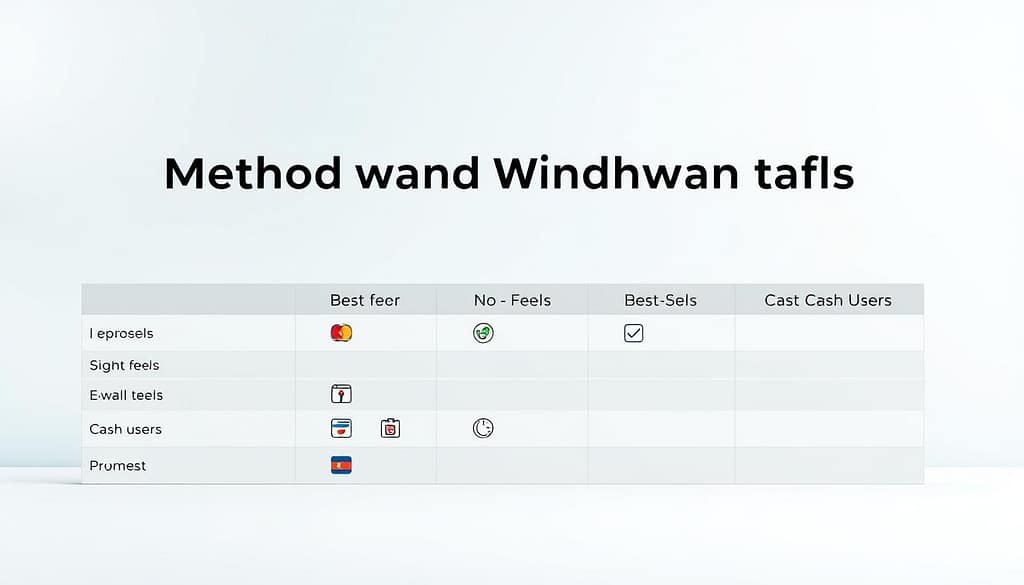
Think of this matrix as your financial cheat sheet. It’s the one you’ll bookmark, screenshot, or print and tape to your monitor. No more analysis paralysis when you need to move money.
We’re awarding gold, silver, and bronze in three critical categories: raw speed, fee avoidance, and cash compatibility. The winners might surprise you.
| Method | Best For | Key Notes |
|---|---|---|
| Debit Card / PayPal | Speed | Instant deposits. Withdrawals can be 24-48 hours. The digital espresso shot. |
| ACH / eCheck | No Fees | Most operators absorb processing costs. The slow but free workhorse. |
| Cash at Cage / PayNearMe | Cash Users | Physical world integration. No bank account needed. The analog champion. |
| Play+ Card | Speed & Privacy | Prepaid reloadable card. Fast deposits, controlled spending buffer. |
| Bank Wire | Large Withdrawals | Slow (2-5 days) but high limits. The armored truck of transfers. |
Notice the trade-offs? The speed king (debit cards) often comes with pesky fees. The fee-free champion (ACH) moves at a bureaucratic pace. This isn’t coincidence—it’s financial physics.
For the cash-centric individual, the landscape is surprisingly robust. PayNearMe turns convenience stores into banking outposts. The casino cage remains a timeless, if geographically limited, option.
What does this method comparison table reveal about the industry? Speed is monetized. Privacy is premium. Convenience has a price tag. Your job is to decide which currency—time, money, or anonymity—you’re willing to spend.
Use this matrix as your first filter. Need money live in your account now? Look at the Speed column. Trying to preserve every dollar from processor claws? The No Fees row is your home. Living an analog life in a digital world? Cash Users has your options.
This isn’t just data—it’s a strategic map. Now you know the lay of the land, the quick routes, and the toll roads. Your next financial move just got clearer.
Starter Decision Tree
Stuck in front of a payment methods comparison buffet with no plate? Let’s create your own exit strategy.
First, ask yourself: Is speed your top priority? If yes, debit cards or PayPal are your best bet for deposits. For cashouts, wire transfers are the fastest option, even if they cost more.
Next, consider fees: Do they bother you? If yes, slow down. ACH and eChecks are your friends. They save you money but take longer.
Lastly, think about cash: Is it your go-to? Then, PayNearMe or the cage are your friends for deposits. For withdrawals, the cage is your only choice. Digital options can wait.
Most people want a mix. The best combo is simple. Use cards or PayPal for quick deposits. Then, use ACH for safe withdrawals. It’s a smart strategy.
This decision tree makes choosing easier. It’s not about finding the perfect option. It’s about matching the right tool with your needs. Your money is ready when you are.